
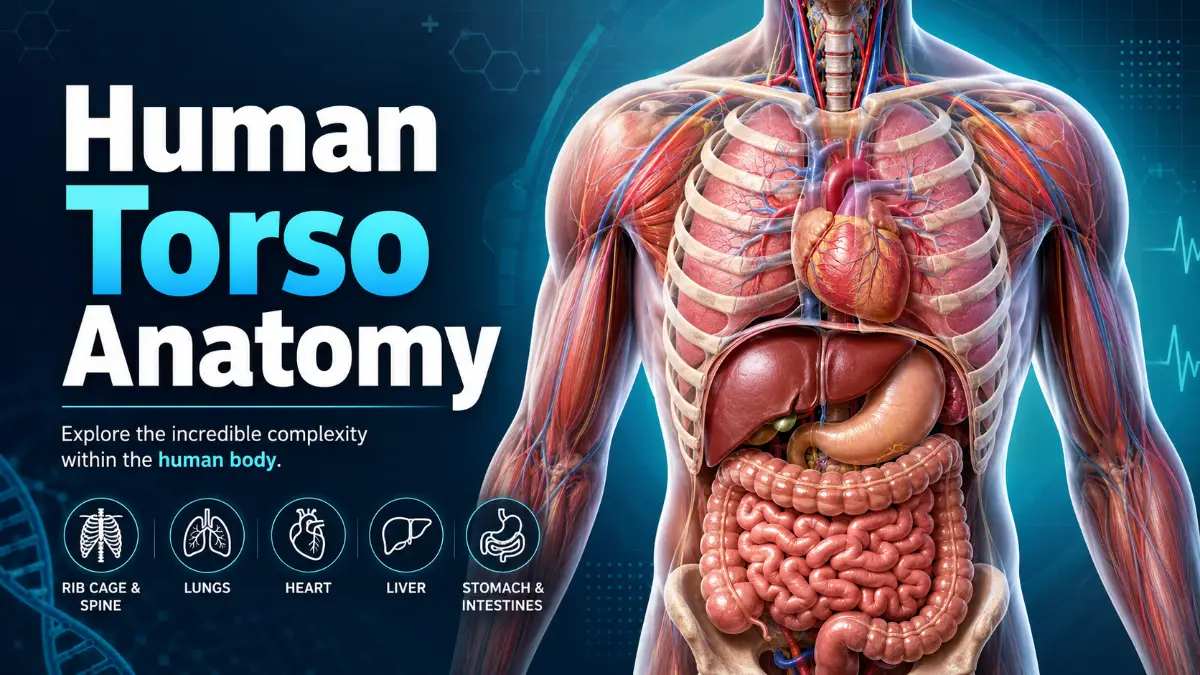
Human torso anatomy describes the structure of the trunk, the central region of the body between the neck and the pelvis. The torso includes the chest, abdomen, and pelvic region and contains major structures involved in breathing, circulation, digestion, movement, and reproduction.
The torso is supported by the vertebral column, ribs, sternum, and pelvic bones. Its muscles help maintain posture, move the trunk and limbs, and support breathing, while its cavities protect and organize many internal organs.
What Is the Human Torso Anatomy?
The torso, also called the trunk, is the central part of the human body that connects the neck with the pelvis and provides attachment points for the upper and lower limbs.
For basic anatomical description, the torso can be divided into three major regions:
- Thorax (chest): The upper part of the torso, extending from the base of the neck to the diaphragm.
- Abdomen: The region between the diaphragm and the pelvic brim that contains many digestive and other internal organs.
- Pelvis: The lower portion of the trunk, formed around the pelvic bones and containing the pelvic cavity and pelvic organs.
These regions are closely connected rather than functioning as completely separate areas. The diaphragm separates the thoracic cavity from the abdominal region, while the abdomen and pelvis form the continuous abdominopelvic region.
Skeletal Framework of the Torso
The skeletal framework gives the torso its shape, provides attachment points for muscles, supports the body, and protects important internal structures.
The major bones and structures include:
- Rib cage
- Sternum
- Thoracic vertebrae
- Lumbar vertebrae
- Sacrum
- Coccyx
- Pelvic bones
Together, these structures form a strong but flexible framework that supports movement while protecting organs.
Rib Cage and Sternum
The thoracic cage, commonly called the rib cage, consists primarily of 12 pairs of ribs, the sternum, costal cartilage, and the thoracic vertebrae.
The ribs are classified into three groups:
- True ribs (1–7): Attach directly to the sternum through their costal cartilage.
- False ribs (8–10): Attach indirectly to the sternum through the cartilage of the rib above.
- Floating ribs (11–12): Do not attach to the sternum anteriorly.
The rib cage protects the heart, lungs, and other structures within the thorax. It also moves during breathing as the muscles of the thoracic wall and diaphragm change the volume of the chest.
The sternum, or breastbone, forms the front of the thoracic cage. It has three main parts:
- Manubrium
- Body
- Xiphoid process
Also Read: Emergency Dentist: What to Do When You Need Immediate Dental Care
The Spine
The vertebral column, or spine, forms the posterior central framework of the torso and extends from the base of the skull to the coccyx.
It is divided into five regions:
- Cervical: 7 vertebrae in the neck
- Thoracic: 12 vertebrae, designated T1–T12
- Lumbar: 5 vertebrae in the lower back
- Sacral: 5 fused vertebrae forming the sacrum
- Coccygeal: Usually 3–5 fused vertebrae forming the coccyx
The exact number of coccygeal vertebrae can vary between individuals. The spine supports the body, provides attachment points for muscles and ribs, permits bending and rotation, and protects the spinal cord.
The Pelvis
The pelvis forms the lower skeletal framework of the trunk and connects the spine with the lower limbs.
The bony pelvis includes the:
- Right and left hip bones
- Sacrum
- Coccyx
The pelvis provides structural support, transfers weight between the trunk and legs, and surrounds the pelvic cavity. The pelvic region also contains muscles and connective tissues that support pelvic organs.
Muscles of the Torso
The torso contains many muscles that work together to control movement, stabilize the spine, maintain posture, and assist breathing.
Important muscle groups include:
Pectoral Muscles
The pectoralis major and pectoralis minor are located on the front of the chest. They contribute to movement of the shoulder and upper limb.
Abdominal Muscles
Important abdominal muscles include:
- Rectus abdominis
- External oblique
- Internal oblique
- Transversus abdominis
These muscles help move and stabilize the trunk and contribute to abdominal wall tension and pressure.
Back Muscles
The back contains several muscle groups that support the vertebral column and control movement. The erector spinae group helps extend and stabilize the spine, while muscles such as the latissimus dorsi contribute to movement of the upper limb.
Intercostal Muscles
The intercostal muscles occupy spaces between the ribs. They help move the thoracic wall during breathing.
Diaphragm
The diaphragm is a dome-shaped skeletal muscle positioned beneath the lungs. It forms the floor of the thoracic cavity and separates the thorax from the abdominal region.
When the diaphragm contracts, it moves downward and increases the volume of the thoracic cavity, contributing to inhalation.
Internal Cavities and Organs
One of the most important aspects of human torso anatomy is the organization of internal body cavities.
The major cavities associated with the torso are the:
- Thoracic cavity
- Abdominal cavity
- Pelvic cavity
The thoracic and abdominopelvic cavities are part of the body’s larger ventral cavity system.
Thoracic Cavity
The thoracic cavity is located inside the chest and above the diaphragm.
It contains:
- Lungs
- Heart
- Trachea
- Esophagus
- Major blood vessels
- Other nerves, lymphatic structures, and connective tissues
The thoracic cavity includes two pleural cavities, which surround the lungs, and the mediastinum, the central region between them that contains the heart and several other structures.
Read More: Tubby Todd Review: Products, Ingredients, Prices, and Whether It’s Worth Buying
Abdominal Cavity
The abdomen lies below the diaphragm and above the pelvic brim.
Important organs associated with the abdominal region include:
- Stomach
- Liver
- Gallbladder
- Pancreas
- Small intestine
- Large intestine
- Spleen
- Kidneys
The kidneys deserve a specific distinction: they are located in the posterior abdomen and are retroperitoneal, meaning they lie behind the main peritoneal cavity rather than freely within it.
The abdominal region plays major roles in digestion, nutrient absorption, metabolism, waste processing, and several other physiological functions.
Pelvic Cavity
The pelvic cavity is located within the bony pelvis.
Depending on sex and anatomy, important structures in this region include:
- Urinary bladder
- Rectum
- Internal reproductive organs
- Associated blood vessels, nerves, muscles, and connective tissues
The pelvic cavity is continuous with the abdominal cavity as part of the broader abdominopelvic region. The boundary between the abdominal and pelvic regions is commonly described using the pelvic brim rather than a separating membrane.
Torso Anatomy at a Glance
| Region | Approximate Location | Major Skeletal Structures | Important Organs and Structures |
| Thorax | Neck to diaphragm | Ribs, sternum, T1–T12 vertebrae | Heart, lungs, trachea, esophagus |
| Abdomen | Diaphragm to pelvic brim | Lumbar vertebrae and lower ribs provide posterior support | Stomach, liver, gallbladder, pancreas, intestines, spleen, kidneys |
| Pelvis | Lower trunk within the pelvic ring | Hip bones, sacrum, coccyx | Bladder, rectum, reproductive organs |
How the Torso Supports the Body
The torso serves several interconnected functions.
Protection
The rib cage protects important thoracic organs, particularly the heart and lungs. The vertebral column protects the spinal cord, while the pelvis provides a strong protective framework around pelvic structures.
Read More: Smith Machine Guide: Proper Use, Benefits, Risks, and Workouts
Movement and Stability
Torso muscles stabilize the spine and pelvis while allowing movements such as bending, rotation, and extension. They also provide attachment points and mechanical support for movements of the arms and legs.
Breathing
Breathing depends on coordinated movement of the diaphragm, intercostal muscles, rib cage, and other respiratory structures. The diaphragm is especially important because its contraction expands the thoracic cavity and facilitates inhalation.
Internal Organization
The torso’s bones, muscles, connective tissues, membranes, and cavities organize and protect internal organs while allowing those organs to perform their functions.
Torso vs. Abdomen vs. Chest
These terms are related but are not interchangeable.
- Torso: The broad central region of the body, commonly referring to the trunk.
- Chest: The thoracic region, containing the thoracic cage and thoracic cavity.
- Abdomen: The region below the diaphragm and above the pelvic brim.
- Pelvis: The lower region of the trunk associated with the pelvic bones and pelvic cavity.
Understanding these distinctions makes anatomical descriptions easier to interpret.
Why Human Torso Anatomy Matters
Understanding human torso anatomy provides a foundation for learning how the body’s major structural systems fit together.
It is especially useful in subjects such as:
- Anatomy and physiology
- Physical therapy
- Sports and exercise science
- Nursing and medicine
- Fitness and strength training
- Radiology and medical imaging
A basic understanding of anatomical regions can also make medical terminology easier to understand, although anatomy alone should not be used to diagnose the cause of pain or other symptoms.
Frequently Asked Questions
What is human torso anatomy?
Human torso anatomy refers to the structures that make up the trunk of the body, including the thorax, abdomen, and pelvic region. It includes bones, muscles, organs, blood vessels, nerves, connective tissues, and body cavities.
What are the main parts of the human torso anatomy?
The main regions of the torso are the thorax, abdomen, and pelvis. The thorax contains the chest and rib cage, the abdomen contains many digestive and other internal organs, and the pelvis contains the pelvic cavity and associated organs.
What organs are located in the human torso anatomy?
Major organs located within the torso include the heart, lungs, stomach, liver, gallbladder, pancreas, spleen, intestines, kidneys, urinary bladder, and reproductive organs.
What bones make up the human torso anatomy?
Important bones and skeletal structures of the torso include the ribs, sternum, thoracic vertebrae, lumbar vertebrae, sacrum, coccyx, and pelvic bones.
How many ribs are in the human torso?
A typical human rib cage contains 12 pairs of ribs, or 24 ribs in total. They are classified as true ribs, false ribs, and floating ribs according to how they attach to the sternum.
What muscles are found in the torso?
Major torso muscles include the pectoral muscles, rectus abdominis, external and internal obliques, transversus abdominis, erector spinae, latissimus dorsi, intercostal muscles, and diaphragm.
Is the abdomen part of the torso?
Yes. The abdomen is one of the major regions of the torso. It lies below the diaphragm and above the pelvic brim and contains many organs involved in digestion and other body functions.
Is the chest part of the torso?
Yes. The chest, or thorax, forms the upper portion of the torso. It includes the rib cage, sternum, thoracic vertebrae, lungs, heart, and other structures within the thoracic cavity.
Is the spine part of the torso?
Much of the spine forms the structural framework of the torso. The thoracic and lumbar regions are particularly associated with the trunk, while the cervical spine belongs to the neck and the sacrum and coccyx form part of the pelvic framework.
What is the role of the diaphragm in human torso anatomy?
The diaphragm is a major muscle involved in breathing. It lies beneath the lungs, separates the thoracic cavity from the abdominal region, and contracts downward to increase the volume of the thoracic cavity during inhalation.
Where are the kidneys located in the torso?
The kidneys are located toward the back of the upper abdominal region on either side of the vertebral column. They are retroperitoneal, meaning they lie behind the main peritoneal cavity.
What is the difference between the torso and the trunk?
In anatomy, torso and trunk are generally used to describe the central portion of the body between the neck and pelvis. “Trunk” is the more formal anatomical term, while “torso” is commonly used in general and educational contexts.