
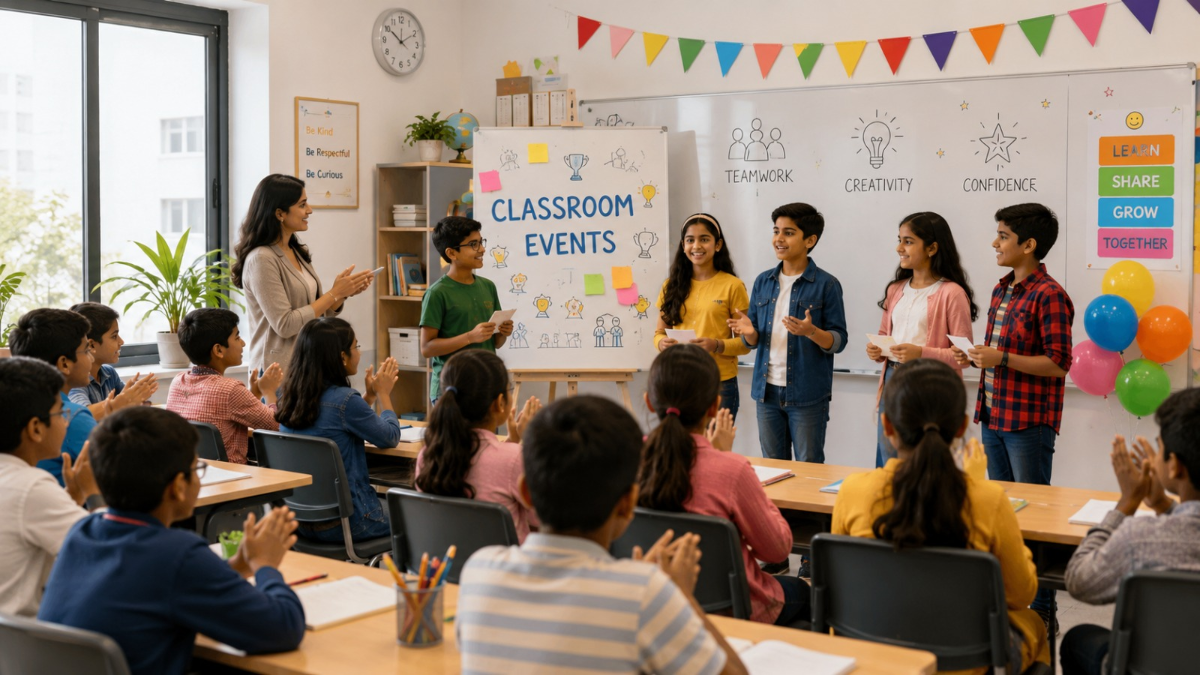
The best classroom events match a clear purpose with your students’ grade level, available time, classroom readiness, and budget. This guide includes practical classroom event ideas for community building, academic review, creativity, collaboration, reflection, and celebration-so teachers can choose activities that work in real classrooms, not just on paper.
Use the seasonal sections as flexible planning examples, not fixed rules. Your school’s calendar, testing schedule, climate, instructional cycle, and class dynamics should determine when an event is appropriate.
Choose classroom events by goal first. Then check time, grade level, preparation required, available materials, class size, and whether every student has an accessible way to participate.
Choose the Right Classroom Event
A successful classroom event does not need expensive decorations, elaborate planning, or a full day away from instruction. It needs a clear goal, simple directions, and a format your students can manage.
Before choosing from a list of classroom activities for students, decide what you want the experience to accomplish.
| If your goal is to… | Choose this classroom event | Best time to use it | Prep level |
| Build community | Get-to-Know-You Scavenger Hunt | Early in the year or with a new class | Low |
| Reset expectations | Class Constitution or Norms Refresh | Start of term or after a break | Low |
| Review learning | Trivia Review Challenge or Peer Tutoring Swap | Before an assessment | Low to medium |
| Encourage creativity | Poetry Café | After a writing unit | Medium |
| Build collaboration | STEM Challenge Friday | Once group routines are established | Medium |
| Celebrate progress | Student-Curated Museum Day | End of a unit or school year | Medium |
| Reflect on growth | Time Capsule Ceremony | End of a term or year | Low |
| Create daily connection | Mystery Student Interview | Any time | No prep |
Event, activity, routine, or challenge?
Teachers often use these terms interchangeably, but distinguishing them helps with planning.
Also Read: Generation Genius
| Format | Definition | Example |
| Classroom event | A planned experience with a clear beginning and end | Student-Curated Museum Day |
| Classroom activity | A focused task within a lesson or event | Writing a reflection card |
| Classroom routine | A short practice repeated regularly | Mystery Student Interview |
| Classroom challenge | A multi-day or multi-week experience with a cumulative goal | Kindness Chain Challenge |
A book tasting is an activity. A reading celebration built around several stations, student choices, and a final commitment can become an event. That distinction matters because events usually need more planning, transitions, and reflection.
How to choose a classroom event in 60 seconds
Use this quick decision guide when you need an idea without spending an hour searching for fun classroom events.
- Name the goal. Do students need connection, review, creativity, collaboration, celebration, or reflection?
- Check your time. A 10-minute routine needs a different format from a 45-minute event.
- Match the grade level. Younger students need more structure, while older students can manage greater choice and leadership.
- Check your prep capacity. Choose a no-prep, low-prep, or project-based format based on your workload.
- Look at materials and budget. Use existing classroom supplies whenever possible.
- Plan an accessible participation route. Every student should have at least one meaningful way to take part.
- Prepare a backup. Keep a short written reflection, partner discussion, or review task ready if the schedule changes.
Classroom events by time available
| Time available | Suitable formats |
| 5–10 minutes | Mystery Student Interview, discussion prompt, exit reflection, quick peer appreciation |
| 15–20 minutes | Norms refresh, mini scavenger hunt, desk-decorating activity, vocabulary challenge |
| 30–45 minutes | Trivia Review Challenge, Book Tasting, Poetry Café, Mystery Box Investigation |
| 45–60 minutes | STEM Challenge Friday, podcast recording, museum day, showcase |
| Half day or longer | Field games, family engagement event, larger student exhibition |
Classroom events by grade level
| Grade band | Prioritize |
| K–2 | Visual instructions, movement, repetition, brief participation, teacher-led structure |
| Grades 3–5 | Small groups, defined roles, light competition, hands-on tasks |
| Grades 6–8 | Choice, collaboration, discussion, creative problem-solving |
| Grades 9–12 | Student leadership, independent planning, presentation, academic depth |
Seasonal Classroom Event Ideas
Seasonal planning helps teachers pace events across the year. However, classroom readiness matters more than the calendar. A class with changed enrolment, weakened routines, or a difficult transition may need a lower-pressure, more structured activity-even late in the year.
Start-of-year classroom events
Use these classroom event ideas when students are learning names, routines, and expectations. Keep activities predictable, short, and low-risk.
| Event | Type | Grades | Class time | Prep | Cost | Best for |
| Get-to-Know-You Scavenger Hunt | Event | 3–12 | 15–20 min | 10–15 min | Free | Community building |
| Class Constitution Signing | Event | K–12 | 25–30 min | 10 min | Free | Shared expectations |
| Desk or Locker Decorating | Activity | K–8 | 15–20 min | 10 min | Existing supplies | Classroom belonging |
| Mystery Student Interview | Routine | K–12 | 5–10 min | None | Free | Daily connection |
| Goal-Setting Vision Board | Activity | 3–12 | 30–40 min | 15–20 min | Free/low-cost | Goal setting |
Get-to-Know-You Scavenger Hunt
Give students a sheet with eight to ten prompts such as “Find someone who enjoys drawing,” “Find someone who has read a mystery book,” or “Find someone who likes to play a sport.” Students circulate and write one classmate’s name next to each prompt.
Keep questions light and optional. Avoid prompts involving family income, religion, health, immigration status, home life, or other personal information that students may not want to discuss.
For younger grades, use picture-based clues and allow students to work with a partner. For older students, use prompts related to interests, future plans, favourite subjects, or learning preferences.
Class Constitution Signing
Ask small groups one central question: How should people in this classroom treat one another? Gather student ideas, combine the strongest into a short class constitution, and invite students to sign it.
The important step comes after the signing. Revisit the constitution after conflicts, transitions, long breaks, or changes in classroom expectations. Students are more likely to value classroom agreements when they see them used in real situations.
Mystery Student Interview
Place student names in a jar and invite one student each day to answer two or three low-pressure questions. Questions might include:
- What is one thing you enjoy doing outside school?
- What is one topic you would like to learn more about?
- What is one thing that helps you learn well?
- What is something you are looking forward to this week?
This routine creates connections gradually. It is especially useful for teachers who want a community-building activity without asking every student to speak publicly during the first week.
Midyear classroom events
Once students can work in groups with less teacher prompting, introduce academic review games, reading events, and classroom challenges. Midyear is also a good time to reinforce positive classroom culture.
| Event | Type | Grades | Class time | Prep | Cost | Best for |
| Trivia Review Challenge | Event | 4–12 | 30 min | 20–30 min | Free | Academic review |
| Kindness Chain Challenge | Challenge | K–8 | 5 min daily | 10 min | Existing supplies | Community culture |
| Book Tasting | Activity | 3–8 | 30–40 min | 15–30 min | Existing supplies | Reading interest |
| Winter Cultures Showcase | Event | K–8 | 45–60 min | 30+ min | Low-cost/school-supported | Cultural learning |
| Global Pen-Pal Exchange Day | Event | 3–12 | 45–60 min | 30+ min | Free/low-cost | Perspective-building |
Trivia Review Challenge
Turn recent learning into a team-based review event. Use a visible timer, a board for points, and questions that reward explanation as well as recall.
Possible rounds include:
- Multiple-choice questions
- True-or-false corrections
- “Explain your answer” questions
- Visual clue rounds
- Vocabulary match-ups
- Student-created questions
For grades 9–12, let students submit questions in advance. Review them before the event so the content remains accurate, relevant, and fair.
Teacher tip: Keep teams small enough for every student to contribute. In large classes, assign roles such as reader, recorder, spokesperson, and checker.
Kindness Chain Challenge
Students write down specific kind actions they notice, such as “Sam helped me understand the directions” or “Aisha included me in the group.” Add each note to a growing paper chain displayed in the classroom.
Set a clear ending point: a Friday celebration, a target chain length, or a final reflection day. A challenge without a visible finish line often loses energy.
Keep the focus on genuine observed actions, not popularity or competition. Students should not be pressured to collect recognition for themselves.
Read More: Fruit Riot
Book Tasting Event
Set up book stations with short excerpts, covers, genre labels, and brief descriptions. Students rotate through stations and complete a simple reading “menu.”
Include prompts such as:
- A book I would like to read now
- A book that surprised me
- A genre I want to explore
- A book I would recommend to a classmate
This educational classroom activity helps students make reading choices while giving teachers useful information about class interests.
Winter Cultures Showcase
Avoid centering the event on one assumed holiday tradition. Instead, invite students to explore how different communities, regions, and families mark seasonal changes, winter celebrations, or important cultural occasions.
Students should have multiple participation choices. They might research a tradition, create an informational poster, recommend a book, share a piece of music, prepare a map, or analyse a seasonal custom. No student should feel required to represent an entire culture or disclose private family practices.
New-term and spring classroom events
After a long break, reset routines before moving into highly independent work. Spring often works well for creative showcases, collaboration, applied learning, and student-led formats.
| Event | Type | Grades | Class time | Prep | Cost | Best for |
| New Semester Norms Refresh | Event | K–12 | 20 min | 5–10 min | Free | Resetting expectations |
| Genius Hour Kickoff | Launch event | 4–12 | 40–50 min | 20–30 min | Free | Student inquiry |
| Peer Tutoring Swap Day | Activity | 4–12 | 30 min | 10–15 min | Free | Review and collaboration |
| STEM Challenge Friday | Event | 3–12 | 40–50 min | 30+ min | Existing supplies/low-cost | Applying concepts |
| Poetry Café | Event | 4–12 | 30–40 min | 15–20 min | Free/low-cost | Creative expression |
| Mystery Box Investigation | Activity | K–8 | 20–30 min | 10–15 min | Free | Reasoning and inquiry |
New Semester Norms Refresh
Revisit the class constitution or shared agreements and ask students:
- What is working well?
- What has become difficult?
- Which agreement needs more attention?
- What one change would help us learn better?
Choose one or two clear improvements rather than rewriting every rule. This keeps the event purposeful and helps students connect expectations with their day-to-day learning environment.
Genius Hour Kickoff
Students choose a topic, question, or skill they want to explore over several weeks. Before they begin, ask them to create a short project pitch that answers:
- What do I want to learn, investigate, or create?
- Why does this topic interest me?
- What materials or information might I need?
- What will my final product look like?
- How will I show what I learned?
For younger students, offer a small menu of teacher-approved topics. For older students, add research checkpoints, source-evaluation requirements, peer feedback, and a final presentation plan.
Peer Tutoring Swap Day
Pair students by topic rather than by perceived ability. Each student should have an opportunity to explain something they understand and ask for support with something they are still learning.
Use a simple four-part structure:
- Student A explains a concept.
- Both students complete a short practice task.
- Student B explains a different concept.
- Partners complete one shared check-for-understanding question.
This format prevents students from being permanently placed in “helper” and “helped” roles.
STEM Challenge Friday
Give groups a practical task linked to current science, mathematics, design, or engineering learning. Examples include building the tallest paper tower, designing a bridge from limited materials, or creating a solution to a measurement problem.
Every STEM Challenge Friday should include:
- A clear task
- Limited materials
- A time limit
- Defined success criteria
- Group roles
- A reflection question
For younger students, simplify the task to one key challenge. For older students, add calculations, design constraints, evidence requirements, or a revision round after testing.
Poetry Cafe
Turn the classroom into a calm reading space where students can share original poems, short writing, or selected literary work. Dimmed lights, a designated reading area, and simple table displays can create atmosphere without requiring a party-sized budget.
Public reading should always be optional. Students may choose to:
- Read aloud
- Display their work
- Submit it for anonymous teacher reading
- Record an audio version
- Share in a small group
- Participate as an audience member and responder
This makes Poetry Café one of the most adaptable classroom celebration ideas for creative learning.
End-of-year classroom events
The final weeks of school should feel positive without becoming unstructured. The strongest end-of-year events help students recognise growth, share meaningful work, and leave with closure.
| Event | Type | Grades | Class time | Prep | Cost | Best for |
| Time Capsule Ceremony | Event | 3–12 | 30 min | 10–15 min | Free | Reflection |
| Student-Curated Museum Day | Event | 3–12 | 45–60 min | 30+ min | Free/low-cost | Celebrating learning |
| Talent or Variety Showcase | Event | K–12 | 60 min | 30+ min | School-supported | Individual strengths |
| Spring Field Games | Event | K–8 | Half day | 30+ min | School-supported | Team building |
| Water Play Wind-Down | Celebration | K–8 | 30 min | 20+ min | School-approved | Outdoor celebration |
Time Capsule Ceremony
Students write letters to their future selves about what they learned, what challenged them, and how they changed. They can also include one goal for the next grade level.
Keep letters private unless students choose to share. Decide in advance whether letters will be returned the following year, sent home, or stored by the school.
Student-Curated Museum Day
Students select their strongest work from the year and create a small exhibit at their desk, a shared table, or a display board. Each exhibit should answer:
- What does this work show?
- What did I learn?
- What was challenging?
- What would I improve now?
- Why did I choose this piece?
Students can guide classmates, younger students, staff members, or invited families through the exhibits. This event celebrates progress, not just polished final products.
Classroom Events by Budget, Class Size, and Inclusion
Practical planning is what turns good classroom event ideas into events teachers can actually run.
Classroom events by budget
| Budget level | Good options | Planning note |
| Free | Mystery Student Interview, Class Constitution, Trivia Review Challenge, Poetry Café, Time Capsule, Peer Tutoring Swap Day | Use existing classroom materials, a board, and a timer |
| Existing classroom supplies | Scavenger Hunt, Kindness Chain, Book Tasting, Mystery Box Investigation | Use paper, pencils, markers, books, and recycled materials |
| Low-cost optional materials | STEM Challenge Friday, Museum Day, desk displays, small showcase items | Provide no-cost alternatives for participation |
| School-funded or approval-dependent | Field games, family events, staged showcases, water play | Confirm policy, supervision, accessibility, and backup arrangements |
Free classroom event ideas
Teachers looking for no-budget school classroom events can start with:
- Mystery Student Interview
- Class Constitution Signing
- New Semester Norms Refresh
- Trivia Review Challenge
- Peer Tutoring Swap Day
- Poetry Café
- Time Capsule Ceremony
- Goal-setting reflection
- Mystery Box Investigation
- Student-led discussion circle
A free event should not rely on families purchasing food, costumes, gifts, special clothing, or materials. If contributions are invited, participation must remain fully optional and a no-cost alternative should always be available.
Classroom events by class size
| Classroom situation | Best formats | Practical adjustment |
| Under 15 students | Poetry Café, inquiry discussion, museum day, whole-class reflection | Use more individual sharing and conversation |
| 15–30 students | Book tasting, trivia, peer tutoring, STEM challenges | Use groups of three to five students |
| 30+ students | Rotating stations, fixed teams, group trivia, structured challenges | Use visual directions, timers, and assigned roles |
| Multi-grade classroom | Tiered tasks, choice boards, Mystery Box Investigation, STEM activities | Create easier and more advanced versions of the same task |
| Virtual or hybrid classroom | Written reflection, digital trivia, book talks, podcast planning | Offer low-bandwidth and non-video participation options |
| Substitute-led classroom | Scavenger hunt, reflection sheets, simple discussion prompts | Use fully written directions and curriculum-independent tasks |
How to make classroom events inclusive
Every classroom event should include at least one alternative way to participate.
- Offer written, visual, verbal, and small-group response options.
- Do not require public speaking, performance, or personal disclosure.
- Provide seated, movement-based, and non-movement roles where possible.
- Give multilingual learners visuals, vocabulary support, sentence starters, and partner options.
- Use step-by-step instructions and predictable roles for students who need additional structure.
- Avoid making participation dependent on money, food, family contributions, or supplies from home.
- Consider sensory needs before using loud music, crowded rotations, strong scents, or intense competition.
- Confirm school policy, supervision requirements, accessibility needs, and family communication before planning outdoor, food-based, water-based, or off-site events.
How to Plan and Run Classroom Events
The difference between a memorable classroom event and a stressful one is usually not creativity. It is preparation, pacing, and a clear transition back to learning.
Before the event
- Define one primary goal.
- Check for testing, assemblies, trips, altered schedules, and weather issues.
- Match the format to the class’s current readiness.
- Prepare materials at least one day in advance.
- Assign adult responsibilities for timing, setup, group support, and cleanup.
- Write directions where students can see them.
- Decide how quieter students, multilingual learners, and students with additional needs can participate.
- Prepare a short backup activity.
During the event
Start by explaining the purpose. Students should know whether they are reviewing a unit, practising teamwork, sharing creative work, or reflecting on growth.
Use a visible timer and give transition warnings. In group events, assign roles such as facilitator, materials manager, recorder, presenter, and timekeeper. Clear roles reduce confusion and prevent one student from doing all the work.
If the room becomes noisy or groups lose focus, pause the event rather than repeating directions over the noise. Reset expectations, clarify the next step, and restart with a shorter time window if necessary.
After the event
End with a short debrief. Two minutes is enough.
Ask students:
- What worked well?
- What was difficult?
- What did we learn?
- What would make this event better next time?
A structured closing prevents a high-energy activity from spilling into the next lesson. Use a written reflection, quiet cleanup task, or partner discussion before moving back to regular instruction.
Frequently Asked Questions
What are the best classroom events for students?
The best classroom events depend on the goal. Use a scavenger hunt or Mystery Student Interview for community building, trivia or peer tutoring for academic review, STEM challenges for collaboration, Poetry Café for creativity, and a museum day or time capsule for end-of-year reflection.
What are some free classroom event ideas?
Free classroom events include Class Constitution Signing, Mystery Student Interview, Trivia Review Challenge, Peer Tutoring Swap Day, Poetry Café, Time Capsule Ceremony, written reflection circles, and student-led discussion activities.
Which classroom events need the least preparation?
Mystery Student Interview, New Semester Norms Refresh, peer appreciation, written reflection, Class Constitution discussion, and simple trivia rounds require very little preparation. These are strong options when teachers need meaningful engagement without extensive setup.
What classroom events work well for large classes?
Large classes work best with fixed groups, visual directions, timed rotations, and assigned student roles. Team trivia, book tasting stations, STEM challenges, and museum-style displays are easier to manage than unstructured whole-class activities.
How can classroom events support academic learning?
Educational classroom activities support learning when they connect directly to a unit goal. Trivia can review vocabulary and concepts, peer tutoring can reinforce understanding, STEM challenges can apply mathematical or scientific learning, and museum days can help students reflect on work over time.
How do teachers make classroom events inclusive?
Provide more than one participation option. Students should be able to contribute through writing, drawing, small-group discussion, recording, research, organising materials, or presenting-rather than being required to speak publicly or disclose personal information.
How often should teachers plan classroom events?
A flexible target is one purposeful event, launch, or classroom challenge per month, alongside shorter routines and activities. Use celebrations less often than academic review, relationship-building, and reflection opportunities.
What should teachers prepare before a classroom event?
Prepare materials, visible directions, group roles, a timer, accessibility options, a cleanup plan, and a backup activity. Confirm any school approval requirements before events involving outdoor space, food, families, water, or special equipment.