
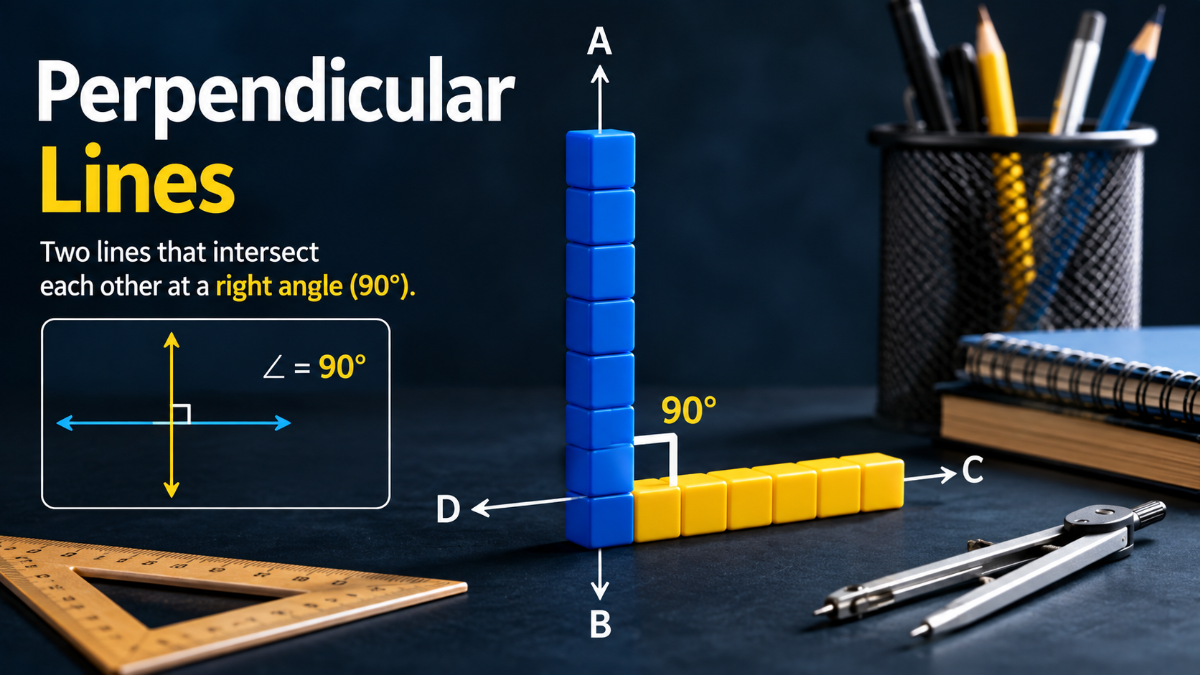
Perpendicular lines are lines that intersect at exactly 90°. The symbol for perpendicular is ⊥. In coordinate geometry, two non-vertical lines are perpendicular when their slopes are negative reciprocals, which means their slopes multiply to −1.
Perpendicular lines are one of the most important relationships in geometry. They help students recognize right angles, interpret diagrams, solve coordinate problems, construct shapes accurately, and prove geometric theorems. You can find perpendicular lines in squares, rectangles, coordinate axes, triangle altitudes, tangent circles, building corners, and grid-based designs.
Perpendicular Lines at a Glance
| Concept | Rule or meaning |
| Perpendicular lines | Lines that meet at a right angle |
| Perpendicular angle | 90° |
| Symbol | ⊥ |
| Non-vertical slope rule | m1 × m2 = −1 |
| Horizontal line slope | 0 |
| Vertical line slope | Undefined |
| Horizontal and vertical lines | Perpendicular when they intersect |
| Perpendicular bisector | Divides a segment equally at 90° |
| Common examples | Coordinate axes, rectangle corners and square diagonals |
What Are Perpendicular Lines?
Perpendicularity describes two lines, line segments, or rays that intersect to form a right angle of 90°.
If line AB and line CD meet at a right angle, write:
AB ⊥ CD
The point where they meet is called the point of intersection.
In geometry diagrams, a small square at a corner is the conventional notation showing that the marked angle is a right angle, which measures 90°. This mark gives direct evidence that the sides or lines forming the angle are perpendicular.
The symbol ⊥ describes the perpendicular relationship. Depending on the diagram, it may refer to complete lines, rays, or line segments.
Important: All perpendicular lines intersect, but not every pair of intersecting lines is perpendicular. The intersection must form an exact 90° angle.
Also Read: Bonefish Grill: Menu, Locations, Happy Hour, and Everything You Need to Know
Perpendicular Lines vs Intersecting Lines
Intersecting lines meet at a point. Their angle can be small, wide, acute, obtuse, or right. Perpendicular lines are a special type of intersecting line because they meet at exactly 90°.
| Type of lines | Do they meet? | Angle condition |
| Intersecting lines | Yes | Can form any angle |
| Perpendicular lines | Yes | Must form 90° |
| Parallel lines | No | Do not meet in the same plane |
For example, two lines that cross at 45° are intersecting but not perpendicular. Lines that cross at 90° are intersecting and perpendicular.
This distinction is useful in exams. A diagram may look like it contains a right angle, but you should not assume perpendicularity unless the diagram includes a right-angle marker, a stated measurement, coordinate evidence, or a known shape property.
Perpendicular Lines Examples in Geometry
Perpendicular lines appear in many familiar figures and coordinate systems.
Coordinate Axes
The x-axis is horizontal, while the y-axis is vertical. They meet at the origin, (0, 0), forming a right angle.
Therefore:
x-axis ⊥ y-axis
This is one of the clearest examples of perpendicular lines in geometry and coordinate graphs.
Adjacent Sides of a Rectangle
A rectangle has four right angles. Each pair of adjacent sides is perpendicular.
If ABCD is a rectangle:
AB ⊥ BC
BC ⊥ CD
CD ⊥ DA
DA ⊥ AB
The opposite sides of a rectangle are parallel, not perpendicular.
Adjacent Sides and Diagonals of a Square
A square has four equal sides and four right angles. Therefore, all neighbouring sides are perpendicular.
A square’s diagonals are also perpendicular. They cross at the centre of the square and form four right angles.
Triangle Altitudes
An altitude of a triangle is a line segment drawn from one vertex perpendicular to the opposite side or the line containing that side.
In a right triangle, the two sides that form the right angle are perpendicular. In an acute or obtuse triangle, altitudes are useful for finding an area and locating the orthocenter.
Radius and Tangent of a Circle
A tangent touches a circle at exactly one point. The radius drawn to that point of contact is perpendicular to the tangent.
If radius OP meets tangent line l at point P:
OP ⊥ l
This relationship is frequently used in circle theorems and geometry proofs.
How to Identify Perpendicular Lines
The best method depends on the information in the question. Do not use a more complicated method when a simpler proof is available.
| Given in the question | Best method |
| Right-angle marker | Identify the marked 90° angle |
| Angle measurement | Check whether the angle equals 90° |
| Two line equations | Compare the slopes |
| Two coordinate pairs | Calculate each slope |
| Horizontal and vertical lines | Use their orientation |
| Named shape | Apply its known properties |
| Segment and midpoint | Check perpendicular-bisector conditions |
Use a Right-Angle Marker
A small square in a diagram proves that the marked angle is 90°. The two lines, rays, or segments forming that angle are perpendicular.
Measure the Angle
When the diagram has no right-angle mark, use a protractor. Place the centre of the protractor on the vertex and align the baseline with one side. If the other side passes through the 90° mark, the angle is a right angle.
Use Known Shape Properties
Geometry shapes have established properties that can prove perpendicularity.
- Adjacent sides of a rectangle are perpendicular.
- Adjacent sides of a square are perpendicular.
- Diagonals of a square are perpendicular.
- Diagonals of a rhombus are perpendicular.
- A right triangle has one pair of perpendicular sides.
- A radius and tangent are perpendicular at the point of contact.
Important: Not every quadrilateral has perpendicular diagonals. Squares and rhombuses have perpendicular diagonals, but a general parallelogram and most rectangles do not.
Perpendicular Lines and Slope
Slope measures how steep a line is and whether it rises or falls from left to right. In coordinate geometry, slope is one of the most reliable ways to prove that two non-vertical lines are perpendicular.
For points (x1, y1) and (x2, y2), use the slope formula:
m = (y2 − y1) ÷ (x2 − x1)
For two non-vertical perpendicular lines:
m1 × m2 = −1
This means their slopes are negative reciprocals.
What Is a Negative Reciprocal?
To find the perpendicular slope of a line:
- Write the original slope as a fraction.
- Reverse the numerator and denominator.
- Change the sign.
| Original slope | Perpendicular slope |
| 2 | −1/2 |
| −5 | 1/5 |
| 3/4 | −4/3 |
| −2/7 | 7/2 |
| 1/6 | −6 |
| −3 | 1/3 |
For example, the negative reciprocal of 2/5 is −5/2.
The negative reciprocal of −4 is 1/4. Write −4 as −4/1, reverse the fraction to get 1/4, then change the negative sign to positive.
Important Limitation of the Slope Rule
The rule m1 × m2 = −1 works only when both lines are non-vertical.
A vertical line has an undefined slope, so it cannot be used in the slope multiplication rule. A horizontal line has slope 0. However, a horizontal line and a vertical line are perpendicular whenever they intersect.
For example:
- y = 4 is a horizontal line.
- x = −2 is a vertical line.
They meet at (−2, 4), so they are perpendicular.
Read More: Fruit Riot: Flavors, Nutrition, Ingredients, Prices & Where to Buy
Example: Test Slopes for Perpendicularity
Consider the two equations:
y = 2x + 5
y = −1/2x + 1
The slope of the first line is 2. The slope of the second line is −1/2.
Now multiply the slopes:
2 × −1/2 = −1
Because the product is −1, the lines are perpendicular.
How to Prove Two Lines Are Perpendicular
A proof of perpendicularity should match the information in the question. You may use an angle, slopes, coordinates, or shape properties.
Prove It Using an Angle
If an angle between two lines measures 90°, the lines are perpendicular.
For example, if angle ABC equals 90°:
AB ⊥ BC
This is the most direct method in a labelled geometry diagram.
Prove It Using Slopes
For two non-vertical lines, find both slopes. If one slope is the negative reciprocal of the other, the lines are perpendicular.
For example, slopes 4 and −1/4 prove perpendicularity because:
4 × −1/4 = −1
Prove It Using Coordinates
When each line is defined by two points, calculate the slope of each line.
Suppose line AB passes through (1, 2) and (5, 8):
mAB = (8 − 2) ÷ (5 − 1)
mAB = 6 ÷ 4
mAB = 3/2
Suppose line CD passes through (2, 5) and (5, 3):
mCD = (3 − 5) ÷ (5 − 2)
mCD = −2 ÷ 3
mCD = −2/3
Now compare the slopes:
3/2 × −2/3 = −1
Therefore, AB is perpendicular to CD.
Prove It Using Shape Properties
A named geometric shape can give enough information to establish perpendicularity.
For example, a rectangle has four right angles by definition. Therefore, each side is perpendicular to its adjacent sides. A rhombus has diagonals that meet at 90°, while a square has both perpendicular sides and perpendicular diagonals.
How to Find a Perpendicular Line Equation
To find the equation of a perpendicular line, you normally need:
- The equation or slope of the original line.
- A point through which the new perpendicular line passes.
The basic process is:
- Find the slope of the given line.
- Find its negative reciprocal.
- Use the new slope and the given point in point-slope form.
Point-slope form is:
y − y1 = m(x − x1)
Here, (x1, y1) is a point on the required line and m is its slope.
Example: Find a Perpendicular Equation Through a Point
Find the equation of a line perpendicular to:
y = 3x − 2
and passing through (2, 4).
The original slope is 3.
The perpendicular slope is −1/3.
Use point-slope form:
y − 4 = −1/3(x − 2)
This equation is already correct.
To write it in slope-intercept form:
y − 4 = −1/3x + 2/3
y = −1/3x + 14/3
So the perpendicular line equation is:
y = −1/3x + 14/3
Example: Find a Perpendicular Equation From Standard Form
Find the equation of a line perpendicular to:
2x + 5y − 10 = 0
and passing through (5, 2).
First, rearrange the original equation into slope-intercept form:
5y = −2x + 10
y = −2/5x + 2
The original slope is −2/5.
The perpendicular slope is 5/2.
Now use point-slope form:
y − 2 = 5/2(x − 5)
This is the equation of the required perpendicular line.
Perpendicular Bisector Explained
A perpendicular bisector is a line, ray, or segment that meets another segment at 90° and divides it into two equal parts.
For line l to be the perpendicular bisector of segment AB, it must meet both conditions:
AM = MB
l ⊥ AB
Here, M is the midpoint of segment AB.
A line can be perpendicular to a segment without being its perpendicular bisector. It becomes a perpendicular bisector only when it crosses the segment exactly at its midpoint.
Perpendicular Bisector Theorem
Any point on the perpendicular bisector of a segment is equally distant from the segment’s endpoints.
If point P lies on the perpendicular bisector of segment AB:
PA = PB
The converse is also true. If a point is equally distant from A and B, then it lies on the perpendicular bisector of segment AB.
This theorem is useful in constructions, triangle geometry, coordinate proofs, and questions involving equal distances.
Perpendicular Lines in Common Shapes
| Shape | Are adjacent sides perpendicular? | Are diagonals perpendicular? |
| Rectangle | Yes | Generally no |
| Square | Yes | Yes |
| Rhombus | Not generally | Yes |
| Parallelogram | Not generally | Not generally |
| Right triangle | One pair of sides | Not applicable |
| Kite | Not generally | One diagonal is perpendicular to the other |
A square is both a rectangle and a rhombus. That is why it has four right angles, equal sides, and diagonals that meet at 90°.
A rectangle has perpendicular adjacent sides, but its diagonals are generally not perpendicular. A rhombus has perpendicular diagonals, but its adjacent sides are not necessarily perpendicular.
How to Draw Perpendicular Lines
You can construct perpendicular lines using graph paper, a ruler and set square, or a compass and straightedge.
Drawing Perpendicular Lines on Graph Paper
- Find the slope of the original line.
- Find the negative reciprocal of that slope.
- Start at the required point.
- Follow the rise-and-run pattern of the new slope.
- Mark a second point.
- Draw a straight line through the two points.
For example, if the original slope is 2/3, the perpendicular slope is −3/2. From the starting point, move 2 units right and 3 units down to locate another point on the perpendicular line.
Drawing With a Set Square
Place one edge of the set square along the original line. Draw along the edge that forms the 90° corner. The new line will be perpendicular to the original line.
This method is useful in practical geometry, technical drawing, and construction exercises.
Read More: Detroit Axle Review: Are Their Suspension, Brake, and Hub Parts Worth Buying?
Constructing a Perpendicular With a Compass
To construct a perpendicular line at a point on a given line:
- Place the compass point on the given point.
- Draw an arc that crosses the line on both sides.
- Keep the compass width unchanged.
- Draw an arc from each crossing point above or below the original line.
- Mark the point where the two arcs meet.
- Draw a line through the original point and the new intersection point.
The result is a line perpendicular to the original line.
Common Exam Questions on Perpendicular Lines
Basic Definition Question
Question: What are perpendicular lines?
Answer: Perpendicular lines are lines that intersect at exactly 90°.
Identify a Right Angle
Question: Two lines meet at 75°. Are they perpendicular?
Answer: No. Perpendicular lines must form an exact 90° angle.
Find a Negative Reciprocal
Question: What is the perpendicular slope of 5/8?
Answer: −8/5.
Test Two Slopes
Question: Are lines with slopes −4 and 1/4 perpendicular?
Answer: Yes, because:
−4 × 1/4 = −1
Identify Horizontal and Vertical Lines
Question: Are x = 7 and y = −2 perpendicular?
Answer: Yes. The line x = 7 is vertical, while y = −2 is horizontal. They form a right angle where they intersect.
Find a Perpendicular Equation
Question: Find the equation of a line perpendicular to y = −2x + 1 and passing through (3, 4).
The original slope is −2.
The perpendicular slope is 1/2.
Use point-slope form:
y − 4 = 1/2(x − 3)
This is a correct equation of the required line.
Common Mistakes to Avoid
- Assuming every pair of intersecting lines is perpendicular.
- Changing the sign of a slope without taking its reciprocal.
- Reversing a slope but forgetting to change its sign.
- Applying the slope multiplication rule when one line is vertical.
- Assuming every quadrilateral has perpendicular diagonals.
- Confusing a perpendicular line with a perpendicular bisector.
- Calling a line a perpendicular bisector without confirming that it passes through the midpoint.
- Confusing the perpendicular symbol ⊥ with the parallel symbol ∥.
The most useful question to ask is: What evidence proves that the angle is exactly 90°?
Frequently Asked Questions
Can two vertical lines be perpendicular?
No. Two vertical lines do not intersect because they run in the same direction, so they are parallel. The same is true for two horizontal lines. A vertical line is perpendicular to a horizontal line when they intersect. For example, x = 4 and y = −1 meet at (4, −1) and form a right angle.
What is the perpendicular slope of 0?
A slope of 0 represents a horizontal line. A line perpendicular to it must be vertical, and vertical lines have undefined slope. Therefore, zero does not have a numerical negative reciprocal for this purpose. Use the orientation rule: a horizontal line and a vertical line are perpendicular when they intersect.
How do you find a perpendicular line equation?
Find the slope of the original line, calculate its negative reciprocal, and use point-slope form with the specified point. For example, if the original slope is 4, the perpendicular slope is −1/4. Through point (2, 3), the equation is y − 3 = −1/4(x − 2).
What is the difference between perpendicular and perpendicular bisectors?
Perpendicular lines meet at 90°. A perpendicular bisector must also divide a segment into two equal parts. A line crossing segment AB is a perpendicular bisector only if it creates a right angle and divides AB into equal lengths, meaning AM = MB.
Are square diagonals perpendicular?
Yes. The diagonals of a square meet at exactly 90°, so they are perpendicular. They also bisect each other and are equal in length. These properties make square-diagonal questions common in coordinate geometry and proof-based exercises.
Are rectangle diagonals perpendicular?
Generally, no. Rectangle diagonals are equal in length and bisect each other, but they do not usually meet at a right angle. A square is the exception because it is a special rectangle with equal sides and diagonals that are perpendicular.
How do you construct a perpendicular line with a compass?
Draw an arc from the given point that crosses the original line in two places. From those two points, draw equal arcs that meet above or below the line. Draw a straight line through the original point and the meeting point of the arcs. The new line is perpendicular to the original line.
Can perpendicular lines have equal slopes?
No. Two non-vertical perpendicular lines have negative reciprocal slopes, not equal slopes. Equal slopes indicate parallel lines. For example, slopes 3 and 3 represent parallel lines, while slopes 3 and −1/3 represent perpendicular lines.
How do you prove perpendicular lines from coordinates?
Calculate the slope of each line using the coordinate pairs. If the slopes are negative reciprocals, the lines are perpendicular. For example, slopes 2/5 and −5/2 multiply to −1. If one line is horizontal and the other is vertical, they are also perpendicular when they intersect.
Where are perpendicular lines used in real life?
Perpendicular lines are used in construction, architecture, engineering, technical drawing, map grids, furniture design, roads, and carpentry. Door frames, window corners, tiled floors, room corners, and graph axes all depend on right angles. Builders use set squares, levels, and measuring tools to check whether edges are perpendicular.