
Medical review status: This article provides evidence-informed educational information. It has not been medically reviewed by a named healthcare professional.
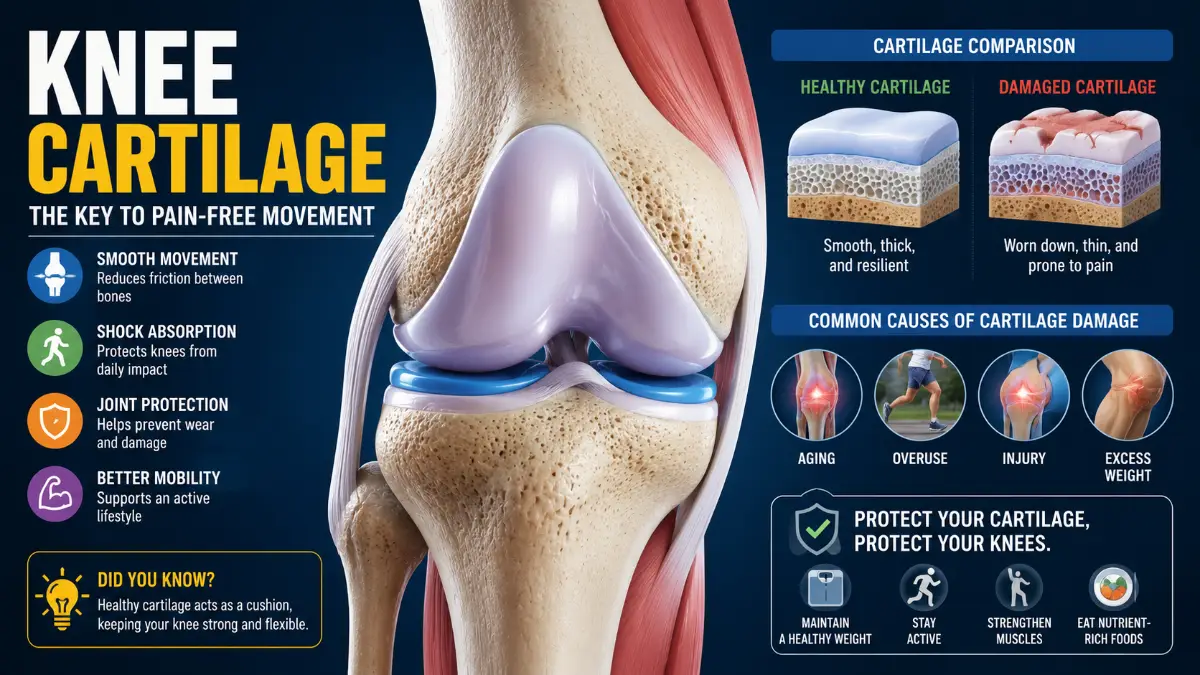
Knee cartilage helps the knee move smoothly, distribute forces across the joint, and tolerate the loads created by walking, climbing stairs, exercising, and playing sports.
When cartilage in the knee is damaged by an injury or affected by a condition such as osteoarthritis, symptoms may include pain, swelling, stiffness, catching, locking, and reduced knee function.
Having knee cartilage damage does not automatically mean you need surgery or should stop exercising. Treatment depends on the structure involved, the size and location of the damage, symptoms, associated injuries, activity level, overall joint health, and whether surgery has been performed. This guide explains what knee cartilage is, what can damage it, common symptoms, diagnosis, exercises, nonsurgical treatment, surgery and recovery, supplements, and whether damaged cartilage can heal or grow back.
Knee Cartilage: Key Takeaways
- Knee cartilage is not a single structure. Articular cartilage covers joint surfaces, while the menisci are fibrocartilage structures between the femur and tibia.
- Articular cartilage has limited natural healing capacity, especially when damage extends through its full thickness.
- Knee cartilage damage does not always require surgery. Physical therapy, appropriate exercise, activity modification, and other nonsurgical treatments may help.
- Exercise is not automatically harmful. Walking, cycling, strengthening, and aquatic exercise may be appropriate depending on the diagnosis.
- Some surgical procedures can repair or restore selected cartilage defects, but this is different from universally regrowing lost cartilage.
- Persistent swelling, locking, instability, severe pain, or difficulty bearing weight should be medically assessed.
What Is Knee Cartilage?
Knee cartilage is connective tissue that helps the knee move smoothly and distribute forces across the joint.
Two structures are commonly discussed when people refer to cartilage in the knee:
- Articular cartilage-smooth tissue covering the joint surfaces
- Menisci-two fibrocartilage structures positioned between the femur and tibia
Although both may casually be called knee cartilage, they have different structures, functions, injuries, and treatment options.
Articular Cartilage
Articular cartilage covers joint surfaces involving the:
- femur, or thigh bone
- tibia, or shin bone
- patella, or kneecap
Its smooth surface allows the bones of the knee to move against one another with low friction while helping distribute forces across the joint. Articular cartilage has limited intrinsic healing capacity. Deeper and full-thickness cartilage defects can therefore be particularly difficult for the body to repair naturally.
Also Read: Tubby Todd Review: Products, Ingredients, Prices, and Whether It’s Worth Buying
Meniscus
Each knee contains two menisci:
- medial meniscus
- lateral meniscus
These fibrocartilage structures sit between the femur and tibia and contribute to load distribution, joint stability, and normal knee mechanics. A meniscus tear is not the same as an articular cartilage defect, even though both problems may sometimes be described broadly as cartilage damage.
Knee Cartilage Damage vs. Meniscus Injury vs. Osteoarthritis
Correct diagnosis matters because these conditions are different and may require different approaches.
| Condition | What It Involves | Common Context |
| Articular cartilage defect | Damage to cartilage covering a joint surface | Trauma, sports injuries, focal cartilage or osteochondral lesions |
| Meniscus injury | Damage to fibrocartilage between the femur and tibia | Twisting injuries or degenerative changes |
| Knee osteoarthritis | Whole-joint disease involving cartilage and other joint tissues | Age, previous injury, body weight, genetics, and other risk factors |
For example, an exercise program appropriate for someone with stable knee osteoarthritis may not be appropriate immediately after an acute cartilage injury or cartilage-restoration procedure.
What Causes Knee Cartilage Damage?
Knee cartilage damage can develop for several reasons.
Traumatic Injury
Sports injuries, falls, direct impacts, and twisting movements can damage cartilage.
A cartilage injury may occur alongside:
- meniscus tears
- ligament injuries
- bone injuries
- kneecap injuries
Symptoms alone do not always reveal exactly which structure has been injured. Significant traumatic knee injuries therefore deserve appropriate medical assessment.
Knee Osteoarthritis
Knee osteoarthritis is more complex than cartilage simply becoming “worn out.”
It is a whole-joint disease that may affect cartilage, bone, synovium, and other structures.
Exercise and other nonsurgical interventions are important components of evidence-based osteoarthritis management.
Previous Knee Injuries
Previous injuries involving cartilage, the menisci, ligaments, or bone may influence joint mechanics and future knee health.
Repetitive Loading
Repeated physical demands may contribute to symptoms in some people, particularly when combined with previous injury or other risk factors. However, this does not mean normal movement or appropriately prescribed exercise automatically destroys knee cartilage.
Other Contributing Factors
The symptoms and progression associated with cartilage damage may also depend on:
- defect size
- defect depth
- defect location
- joint alignment
- age
- physical demands
- previous surgery
- meniscus damage
- ligament injuries
- osteoarthritis elsewhere in the joint
What Are the Symptoms of Knee Cartilage Damage?
Knee cartilage damage symptoms vary depending on the type, location, and severity of the problem.
Possible symptoms include:
- knee pain
- swelling
- stiffness
- reduced range of motion
- discomfort while climbing stairs
- pain during or after activity
- catching sensations
- locking
- difficulty bearing weight
- reduced ability to participate in sports
These symptoms are not specific to cartilage damage.
Meniscus tears, ligament injuries, osteoarthritis, fractures, and other knee conditions can cause similar symptoms. Persistent or significant symptoms therefore deserve clinical assessment rather than self-diagnosis based on symptoms alone.
How Is Knee Cartilage Damage Diagnosed?
Diagnosis generally begins with a medical history and physical examination.
A healthcare professional may ask:
- When did the symptoms begin?
- Was there a twisting injury, fall, or direct impact?
- Where is the pain?
- Does the knee swell?
- Does it catch or lock?
- Does it give way?
- Which activities make symptoms worse?
- Have you previously injured or had surgery on the knee?
Imaging may then be considered when appropriate.
X-Rays
X-rays may help assess:
- bones
- joint alignment
- joint-space changes
- some injuries
- features associated with osteoarthritis
Articular cartilage itself is not directly visible on a standard X-ray.
MRI
Magnetic resonance imaging can provide detailed information about structures including:
- articular cartilage
- menisci
- ligaments
- bone
- tendons
- other soft tissues
However, not everyone with knee pain needs an MRI.
Whether MRI is useful depends on the history, physical examination, suspected diagnosis, and whether the result would change management.
Read More: Smith Machine Guide: Proper Use, Benefits, Risks, and Workouts
Can Knee Cartilage Heal Itself?
Articular cartilage has limited natural repair capacity, particularly when damage extends through its full thickness. However, limited cartilage regeneration does not mean symptoms and function cannot improve. Pain, strength, mobility, and physical function may improve with appropriate nonsurgical management even when the underlying cartilage does not completely regenerate.
For selected focal cartilage defects, surgical procedures may:
- stimulate the formation of repair tissue
- transplant cartilage and underlying bone
- use cell-based cartilage-restoration techniques
These treatments should not be interpreted as making widespread cartilage loss from advanced osteoarthritis simply disappear.
Can Knee Cartilage Grow Back?
This question requires distinguishing between healing, repair, and regeneration. Damaged adult articular cartilage has limited ability to restore itself to normal hyaline cartilage, particularly following full-thickness damage. Some surgical treatments can stimulate repair tissue or restore selected defects using cartilage-and-bone grafts or cell-based techniques.
That is different from naturally regenerating all of the cartilage lost through widespread osteoarthritis. Claims that a food, supplement, or simple exercise can completely regrow knee cartilage should therefore be treated cautiously.
Can You Exercise With Knee Cartilage Damage?
Often, yes-but exercise should match the diagnosis and stage of recovery.
Exercise is an important component of knee osteoarthritis management and may improve pain, strength, mobility, and physical function. Someone with an acute focal cartilage injury or a knee recovering from surgery may have very different restrictions.
Exercise selection may depend on:
- type of cartilage problem
- lesion size
- lesion location
- current pain
- swelling
- strength
- range of motion
- associated injuries
- previous surgery
- rehabilitation stage
The general goal is to maintain or improve function without repeatedly exposing the knee to workloads it cannot currently tolerate.
Knee Cartilage Exercises
There is no single best exercise for knee cartilage damage. Depending on the diagnosis, symptoms, and rehabilitation stage, an exercise program may include the following.
1. Stationary Cycling
Stationary cycling allows resistance, duration, and range of motion to be adjusted. It is commonly incorporated into knee exercise and rehabilitation programs. Even low-impact exercise should follow individual restrictions after an acute injury or operation.
2. Walking
Walking can be an accessible physical activity for many people with stable knee symptoms or osteoarthritis. Start with a manageable distance and gradually increase according to tolerance.
3. Aquatic Exercise and Swimming
Exercising in water changes the amount of load placed through the lower limbs while allowing movement and cardiovascular activity. This may make aquatic exercise useful for people who have difficulty tolerating higher-impact exercise.
4. Quadriceps Strengthening
The quadriceps help control the knee during:
- walking
- climbing stairs
- standing
- sitting
- squatting
- sporting movements
Depending on the diagnosis and rehabilitation stage, exercises may progress through:
- quadriceps isometric contractions
- straight-leg raises
- sit-to-stand exercises
- step-ups
- leg presses
- controlled squats
5. Hip and Glute Strengthening
The muscles around the hip contribute to lower-limb movement and control.
Exercises may include:
- bridges
- hip-abduction exercises
- resisted side steps
- progressively more challenging single-leg movements
Exercise safety: Generic online exercises should not override restrictions provided by your surgeon, physician, or physical therapist.
Read More: Emergency Dentist: What to Do When You Need Immediate Dental Care
Are Squats Bad for Knee Cartilage?
Not automatically.
Saying that every squat damages knee cartilage is too simplistic.
Whether squatting is appropriate depends on:
- diagnosis
- squat depth
- resistance
- technique
- cartilage-lesion location
- pain and swelling
- strength
- rehabilitation stage
- postoperative restrictions
A shallow bodyweight squat creates a different loading situation from a heavily loaded deep squat. Some people may tolerate one while needing to modify or temporarily avoid another.
Can You Run With Damaged Knee Cartilage?
Running is not automatically prohibited for everyone with damaged knee cartilage.
Whether it is appropriate depends on:
- underlying diagnosis
- severity and location of the lesion
- pain
- swelling
- strength
- knee function
- previous surgery
- rehabilitation progress
Running may need to be reduced or temporarily stopped following an acute injury or cartilage-restoration procedure. After surgery, return to running should follow the prescribed rehabilitation plan rather than a generic online timeline.
Are Lunges Bad for Knee Cartilage?
Not necessarily.
As with squats, whether lunges are suitable depends on:
- depth
- resistance
- technique
- symptoms
- lesion location
- strength
- rehabilitation stage
A modified lunge may be tolerated when a deeper or heavily loaded version is not.
Use Your Knee’s Response to Guide Exercise
Pay attention to how your knee responds both during and after physical activity. Consider reducing the load, repetitions, range of motion, duration, or frequency if an exercise repeatedly produces a meaningful increase in:
- pain
- swelling
- limping
- loss of motion
- catching
- locking
Persistent or worsening symptoms should be professionally assessed.
Is Walking Bad for Damaged Knee Cartilage?
Walking is not automatically harmful simply because cartilage damage exists. For many people with stable symptoms or knee osteoarthritis, walking can be an appropriate form of physical activity. The important consideration is how the knee responds to the workload.
If a particular walking distance repeatedly produces substantial swelling, worsening pain, or persistent limping, the workload may need to be reduced and gradually rebuilt. Different advice applies after certain acute injuries or cartilage procedures where weight-bearing has deliberately been restricted.
How Is Knee Cartilage Damage Treated?
Treatment should target the actual diagnosis rather than simply the broad label knee cartilage damage.
Nonsurgical Treatment
Depending on the condition, management may include:
- activity modification
- physical therapy
- progressive strengthening
- aerobic exercise
- gradual return to activity
- weight management when appropriate
- other symptom-management treatments recommended by a healthcare professional
Not every cartilage problem in the knee requires surgery.
Knee Cartilage Surgery
Surgery may be considered for selected symptomatic cartilage lesions.
The decision can depend on:
- lesion size
- lesion depth
- lesion location
- symptoms
- age
- activity demands
- joint alignment
- associated injuries
- response to nonsurgical treatment
Possible procedures include:
- chondroplasty or debridement
- marrow-stimulation procedures such as microfracture
- osteochondral autograft transplantation
- osteochondral allograft transplantation
- cell-based cartilage-restoration procedures such as MACI
The appropriate operation depends on the individual problem. A procedure suitable for a focal cartilage defect is not necessarily appropriate for widespread advanced osteoarthritis.
How Long Does Knee Cartilage Surgery Recovery Take?
There is no universal knee cartilage surgery recovery timeline. Recovery depends on the procedure, lesion size and location, associated procedures, individual healing, rehabilitation progress, and the activity the person wants to resume.
| Procedure | General Recovery Considerations |
| Chondroplasty/debridement | Rehabilitation may progress more quickly than after cartilage-restoration procedures, but recovery varies |
| Microfracture/marrow stimulation | Requires progressive rehabilitation, higher-impact activity may take several months |
| Osteochondral autograft/allograft | The graft generally needs initial protection before progressive strengthening and impact activities |
| MACI/cell-based restoration | Rehabilitation is staged while the repair matures, return to higher-demand activity generally requires months |
These are general considerations rather than guaranteed recovery deadlines.
Returning to desk work, normal walking, running, and competitive sport are different milestones.
Microfracture Recovery
Microfracture creates small openings in the underlying bone to stimulate a repair response.
The resulting repair tissue differs from normal hyaline articular cartilage, so loading and rehabilitation are generally progressed carefully.
Restrictions vary according to:
- lesion location
- lesion size
- associated procedures
- individual progress
- surgeon protocol
Returning to running and pivoting sports may therefore require several months.
OATS and Osteochondral Allograft Recovery
Osteochondral procedures transfer cartilage together with underlying bone into a cartilage defect.
Early rehabilitation generally focuses on protecting the graft.
Rehabilitation may then progressively address:
- range of motion
- muscle strength
- balance
- impact tolerance
- sport-specific movement
Returning to sport should consider biological healing and functional recovery rather than relying only on a calendar date.
MACI Recovery
Matrix-induced autologous chondrocyte implantation (MACI) is a cell-based treatment used for eligible symptomatic full-thickness cartilage defects of the knee. The procedure uses a patient’s cultured cartilage cells on a collagen membrane.
Rehabilitation after MACI is staged and may involve:
- mobilization
- progressive range of motion
- progressive weight-bearing
- strengthening
- functional rehabilitation
- later progression to higher-demand activities
The rehabilitation program should follow the treating physician’s specific protocol.
Do Glucosamine and Chondroitin Rebuild Knee Cartilage?
There is no established evidence that glucosamine or chondroitin supplements regrow damaged knee cartilage. Research examining their effects on knee osteoarthritis symptoms and joint structure has produced inconsistent results. Most importantly, symptom improvement and cartilage regeneration are different outcomes.
Even if someone experiences symptom relief while taking a supplement, that does not prove that damaged articular cartilage has been rebuilt. Glucosamine and chondroitin therefore should not be presented as proven treatments for regenerating knee cartilage.
Are Glucosamine and Chondroitin Safe?
Supplements are not automatically risk-free.
Potential concerns include:
- interaction with warfarin and increased bleeding risk
- possible effects on blood glucose in some people taking glucosamine
- limited safety information during pregnancy and breastfeeding
Discuss supplements with a healthcare professional or pharmacist if you take medication or have other health conditions.
Supplements should not replace appropriate exercise, rehabilitation, medical management, or weight management when these are indicated.
Does Losing Weight Help Knee Cartilage Problems?
For people who are overweight or obese and have knee osteoarthritis, weight management can be an important component of treatment.
Reducing excess body weight can decrease mechanical demands on the knee and may improve osteoarthritis symptoms.
However, weight loss is not a universal treatment for every cartilage injury.
Someone with an acute traumatic cartilage defect still needs the underlying injury properly assessed regardless of body weight.
How to Protect Knee Cartilage
No strategy can guarantee prevention of every cartilage injury, but several habits may support knee health.
Stay Physically Active
Appropriately selected physical activity helps maintain mobility, strength, cardiovascular fitness, and overall health.
Complete inactivity can contribute to stiffness and muscle weakness.
Strengthen the Muscles Around the Knee
Progressive strengthening of the quadriceps, hamstrings, hips, and calf muscles can improve the lower limb’s ability to tolerate everyday physical demands.
Increase Activity Gradually
Avoid sudden large increases in:
- running distance
- walking volume
- jumping
- exercise intensity
- sporting workload
Progressive loading gives the body time to adapt.
Respond to Recurrent Swelling
Repeated swelling after physical activity may indicate that the current workload is not being tolerated well.
That does not necessarily mean permanent rest is required. Instead, the activity or exercise program may need modification.
Manage Body Weight When Relevant
For people who are overweight or obese and have knee osteoarthritis, appropriate weight management may reduce joint loading and improve symptoms.
Follow Postoperative Restrictions
After cartilage-restoration surgery, rehabilitation restrictions are designed to protect healing tissue. Generic online advice should never override instructions provided by the surgical and rehabilitation team.
When Should You See a Doctor for Knee Cartilage Symptoms?
Arrange a medical assessment if knee symptoms:
- persist
- progressively worsen
- repeatedly restrict normal activities
- begin after a significant injury
- cause recurrent swelling
- include catching or locking
- involve repeated giving way
Seek more urgent medical assessment if:
- you cannot bear weight following a significant injury
- the knee becomes severely swollen
- the knee is visibly deformed
- you cannot straighten a locked knee
- severe symptoms follow substantial trauma
- the knee is hot, red, and swollen and you also feel feverish or unwell
A truly locked knee following an acute injury can indicate a mechanical problem that warrants prompt medical evaluation.
Can Knee Cartilage Damage Get Worse?
Some cartilage problems can progress, but progression is not inevitable in every case.
The outlook can depend on:
- type of cartilage involved
- size and depth of the defect
- defect location
- joint alignment
- age
- associated meniscus or ligament damage
- previous injuries
- activity demands
- osteoarthritis elsewhere in the joint
Some defects remain manageable, while others may contribute to persistent symptoms or degenerative joint changes.
Determining the actual diagnosis is therefore more useful than relying solely on the broad label “knee cartilage damage.”
Frequently Asked Questions
What is knee cartilage?
Knee cartilage includes smooth articular cartilage covering the joint surfaces and, in common usage, the fibrocartilage menisci between the femur and tibia. These tissues help the knee move smoothly and distribute forces during movement.
What does damaged knee cartilage feel like?
Possible symptoms include pain, swelling, stiffness, reduced movement, catching, locking, and difficulty performing certain activities. Because these symptoms also occur with other knee conditions, symptoms alone cannot confirm cartilage damage.
Can damaged knee cartilage heal naturally?
Articular cartilage has limited natural repair capacity, particularly when damage extends through its full thickness. However, symptoms and function may improve with appropriate management, and selected defects may be treated with cartilage-restoration procedures.
Can knee cartilage grow back?
Widespread lost articular cartilage does not simply regenerate to its original state. Some surgical procedures can stimulate repair tissue or restore selected focal defects, but this differs from naturally regrowing all damaged cartilage.
Can I exercise with knee cartilage damage?
Often, yes. Appropriate exercise can help maintain or improve strength and function. The correct exercise type and intensity depend on the diagnosis, symptoms, associated injuries, and whether surgery has been performed.
What exercises are good for knee cartilage?
Depending on the condition, stationary cycling, walking, aquatic exercise, quadriceps strengthening, and hip strengthening may be appropriate. There is no single exercise program suitable for every cartilage injury.
Is cycling good for knee cartilage damage?
Stationary cycling is frequently used because resistance and range of motion can be controlled. However, it may not be appropriate at every stage of an acute injury or postoperative rehabilitation program.
Is walking bad for damaged knee cartilage?
Not automatically. Walking may be appropriate for many people with stable symptoms or knee osteoarthritis. Workload may need modification if walking repeatedly produces substantial pain, swelling, or limping.
Are squats bad for knee cartilage?
Not necessarily. Squat depth, load, technique, lesion location, symptoms, strength, and rehabilitation stage all influence whether squatting is appropriate.
Can you run with knee cartilage damage?
Some people can. The decision depends on the underlying diagnosis, symptoms, strength, knee function, lesion characteristics, treatment history, and rehabilitation stage.
Does glucosamine regrow knee cartilage?
There is no established evidence that glucosamine regrows damaged articular cartilage. Research into its effects on symptoms and joint structure in knee osteoarthritis has produced inconsistent results.
Does chondroitin rebuild cartilage?
There is no established evidence that chondroitin rebuilds damaged knee cartilage. It should not be considered a proven cartilage-regeneration treatment.
Does knee cartilage damage always require surgery?
No. Many cartilage problems can initially be managed nonsurgically. Surgery may be considered for selected symptomatic lesions based on lesion characteristics, symptoms, activity demands, associated injuries, and response to nonsurgical treatment.
How long does knee cartilage surgery take to heal?
There is no universal timeline. Recovery depends on the procedure, lesion characteristics, associated procedures, rehabilitation progress, and individual circumstances. Cartilage-restoration procedures may require many months of rehabilitation.
When can I return to sports after knee cartilage surgery?
Return to sport depends on the operation, lesion, healing, strength, symptoms, functional testing, rehabilitation progress, and surgeon clearance. Higher-impact and pivoting sports are generally introduced later than ordinary daily activities.
What is the difference between microfracture and MACI?
Microfracture stimulates a repair response by creating small openings in underlying bone. MACI is a cell-based procedure involving a patient’s cultured cartilage cells on a collagen membrane. The procedures have different indications and rehabilitation requirements.
Does losing weight help knee cartilage problems?
For people who are overweight or obese and have knee osteoarthritis, weight loss may reduce mechanical demands on the knee and improve symptoms. Weight loss is not a universal treatment for every cartilage injury.
What symptoms mean I should stop self-managing my knee?
Persistent swelling, locking, repeated giving way, worsening pain, inability to bear weight following an injury, or symptoms that substantially interfere with normal activities are reasons to seek professional assessment.