
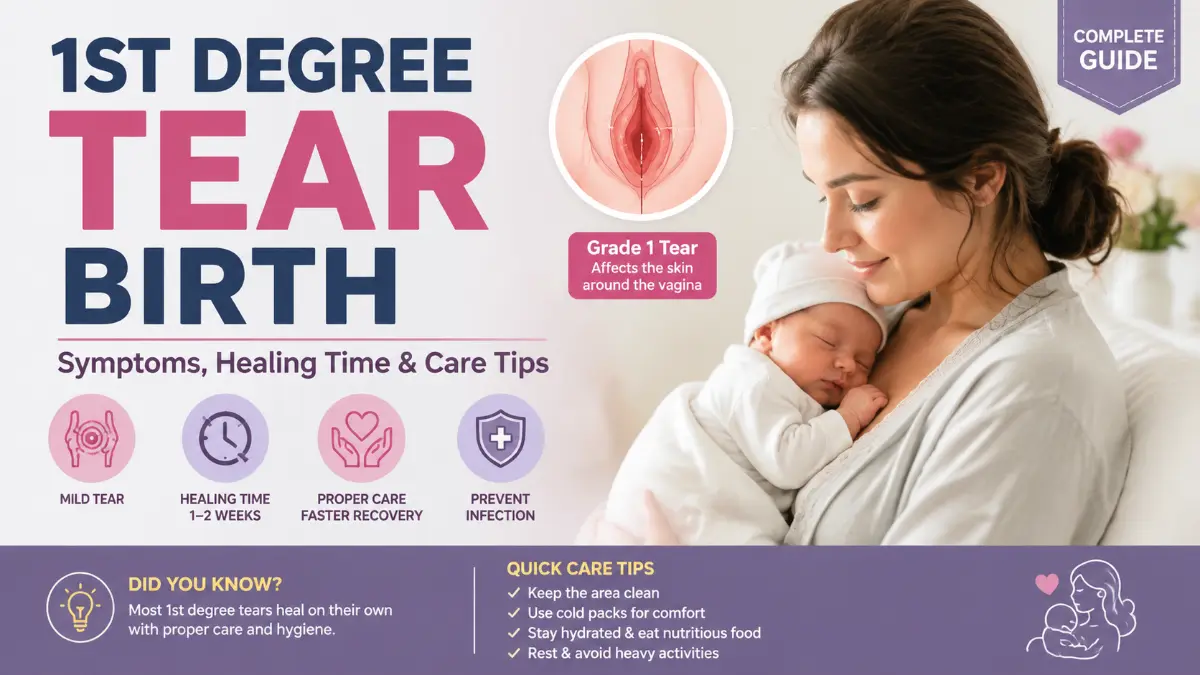
A 1st degree tear birth injury is the mildest recognized degree of perineal tearing after vaginal delivery. It affects superficial tissue rather than the deeper perineal muscles or anal sphincter. Although soreness, stinging and tenderness can make the first days postpartum uncomfortable, first-degree tears usually heal relatively quickly and are unlikely to cause long-term problems.
If you have recently given birth, knowing what was actually injured, whether stitches are needed, how healing normally progresses and which symptoms deserve medical attention can make postpartum recovery much easier to understand.
Medical note: This guide provides general educational information about postpartum perineal tears. It cannot determine the severity of your individual injury or replace an examination by your midwife, obstetrician, GP or other healthcare professional.
What Is a 1st Degree Tear Birth Injury?
A 1st degree tear birth injury is a superficial tear sustained as the vaginal opening and surrounding perineal tissues stretch during childbirth. The Royal College of Obstetricians and Gynaecologists (RCOG) describes first-degree tears as small tears or grazes affecting only the skin. They may occur around the vaginal opening, labia, clitoris or inside the vagina. The key point is that a first-degree tear does not involve the perineal muscle or anal sphincter.
You may hear healthcare professionals use terms such as:
- first-degree perineal tear
- superficial tear
- graze
- abrasion
- vaginal laceration
- superficial perineal laceration
The exact location can vary, so two people with the same tear grade may experience discomfort in somewhat different areas. First-degree tears are at the mild end of the spectrum of birth-related perineal trauma and commonly heal without lasting problems.
First-Degree vs Second-, Third- and Fourth-Degree Tears
Perineal tears are classified according to how deeply the injury extends. The grade matters because deeper tears involve structures that require more extensive repair and follow-up.
Also Read: What Is an Internal Medicine Doctor?
| Tear Grade | Tissue Involved | Usual Management |
| First-degree | Superficial skin tissue | May heal naturally, stitches may be used when clinically needed |
| Second-degree | Skin plus perineal muscle | Usually repaired with stitches |
| Third-degree | Extends into the anal sphincter muscle | Surgical repair is required |
| Fourth-degree | Extends through the anal sphincter into the lining of the anus or rectum | Surgical repair and specialist follow-up are required |
RCOG describes third- and fourth-degree tears collectively as obstetric anal sphincter injuries, or OASI. These are substantially different from a first-degree injury and require more specialized treatment. A rectal buttonhole tear is another uncommon injury. In this situation the rectal lining is injured while the anal sphincter remains intact, so it is not simply another name for a fourth-degree tear.
Tear vs Episiotomy
A spontaneous tear occurs as tissue stretches during the baby’s birth. An episiotomy, by contrast, is an intentional incision made by a healthcare professional through the perineum and vaginal wall when additional space is considered necessary, such as when a baby needs to be born more quickly or in some assisted vaginal deliveries. They therefore should not be treated as interchangeable terms.
Does a First Degree Perineal Tear Need Stitches?
Not every first-degree tear needs stitches. RCOG states that first-degree tears usually heal quickly and without treatment. After delivery, however, your healthcare professional examines the vagina and perineum and determines whether repair is appropriate for the tear you actually have.
The decision can depend on factors that cannot be assessed accurately without examining the wound, including its location, whether the tissue lies together appropriately and whether there is bleeding that requires control.
If stitches are needed, absorbable sutures are commonly used for perineal repairs. These gradually dissolve rather than routinely requiring removal. RCOG notes that people with stitches may notice small pieces of thread as healing progresses.
What if My Tear Was Not Stitched?
A first-degree tear that is intentionally left unsutured is not automatically undertreated. Superficial tears can heal naturally, particularly when no deeper structures are involved. Your own maternity team should tell you how the tear was managed and whether any follow-up is needed. Contact a healthcare professional if an untreated wound appears to be worsening rather than healing, or if you develop increasing pain, unusual discharge, a bad smell or other concerning symptoms.
1st Degree Tear After Birth Healing Time
For most people researching 1st degree tear birth recovery, the most important question is how long the soreness lasts. There is no single day on which every first-degree tear becomes completely healed. RCOG states that the skin portion of a first- or second-degree tear generally heals within a few weeks and tenderness should gradually lessen. A practical way to think about recovery is by stages rather than expecting one exact deadline.
Read More: Human Torso Anatomy: A Complete Guide to the Body’s Core Structure
The First Few Days
During the early postpartum period, you may experience:
- tenderness around the vaginal opening or perineum
- soreness when sitting or walking
- swelling
- stinging when urine contacts the injured area
- sensitivity when cleaning yourself
- irritation from stitches if the tear was repaired
These symptoms should generally move toward improvement rather than becoming progressively worse. Postpartum bleeding also occurs normally after childbirth, so it can be difficult to identify the exact source of every small amount of blood. Sudden heavy bleeding or bleeding that concerns you requires medical assessment rather than being assumed to come from a minor tear.
During the First Few Weeks
The superficial wound should progressively close and become less raw. RCOG advises that the skin part of a perineal wound usually heals within a few weeks. First-degree tears are also considered unlikely to cause long-term problems.
Improvement does not necessarily mean that every sensation disappears immediately. Sitting, walking, bowel movements and sexual activity can put pressure on tissue that has recently healed.
If Recovery Seems Slower Than Expected
Healing is not identical for everyone. Instead of judging recovery only by the calendar, watch the overall pattern. Gradually decreasing pain, tenderness and irritation are reassuring. Pain that is increasing, a wound that appears to be opening, pus-like discharge, an abnormal smell or feeling unwell should prompt medical review.
Childbirth Perineal Tear Care at Home
Good postpartum care is usually simple. The aim is to keep the area clean, minimize irritation and make normal activities such as urination and bowel movements more comfortable.
Keep the Area Clean
RCOG recommends washing the perineal area using water and changing sanitary pads regularly. Washing your hands before and after using the toilet or changing pads also helps reduce contamination of the healing area.
Avoid aggressive scrubbing. If you have specific wound-care instructions from the maternity team that examined you, follow those instructions rather than a generic routine.
Make Urination More Comfortable
Urine can sting when it passes over a superficial tear. Pouring body-temperature water over the perineal area while urinating may reduce the stinging sensation. A peri bottle can make this easier, although the important part is gentle rinsing rather than the specific device used.
Use Cold Therapy Safely
A wrapped cold or ice pack placed over the perineal area can help with postpartum soreness and swelling. Do not put ice directly against the skin because direct exposure can damage tissue. RCOG specifically recommends wrapping an ice pack in a towel.
Avoid Constipation and Straining
Bowel movements are understandably worrying when you have recently delivered a baby and your perineum is sore. Adequate fluid intake and a balanced diet containing fibre can help prevent constipation. RCOG also advises avoiding unnecessary straining and notes that opening your bowels should not cause correctly placed stitches to open.
If constipation is becoming a problem, ask your midwife, doctor or pharmacist about appropriate treatment rather than repeatedly straining.
Ask About Appropriate Pain Relief
Postpartum pain medicines need to be suitable for your health circumstances, allergies, other medications and, where relevant, breastfeeding.
Your maternity team or pharmacist can advise which medicines and doses are appropriate for you. Do not assume that a stronger medication is needed simply because the tear feels sore, even superficial perineal injuries can be uncomfortable in the first days after birth.
Pelvic Floor Recovery After a First-Degree Tear
A first-degree tear itself does not damage the perineal muscles, but pregnancy and vaginal birth still place significant demands on the pelvic floor. RCOG recommends beginning pelvic floor exercises as soon as you are able after birth because they help strengthen the muscles surrounding the vagina and anus and can support postpartum recovery.
If you experience urinary leakage, bowel-control problems, difficulty controlling wind, vaginal heaviness or persistent pelvic pain, discuss the symptoms with a healthcare professional. Do not assume that bowel-control symptoms are normal simply because you were told you had only a first-degree tear.
Read More: Tubby Todd Review: Products, Ingredients, Prices, and Whether It’s Worth Buying
When Can You Have Sex After a First-Degree Tear?
There is no universal number of days after childbirth when penetrative sex becomes appropriate for everyone. Before resuming intercourse, the tear should be healing, postpartum bleeding and discomfort should be considered, and you should personally feel physically and emotionally ready.
Even after a superficial wound has closed, the area may initially feel more sensitive. Postpartum hormonal changes can also contribute to vaginal dryness, particularly for some people who are breastfeeding. Stop if intercourse is painful rather than trying to push through significant discomfort.
Persistent pain, bleeding associated with the scar or pain that is not gradually improving deserves evaluation by a healthcare professional. Remember that pregnancy can occur again postpartum, so contraception is a separate consideration from whether the tear has healed.
Why Do Perineal Tears Happen?
During vaginal birth, the baby’s head stretches the vaginal opening and perineal tissues. Sometimes the tissue stretches without injury, sometimes a spontaneous tear develops.
Perineal trauma is particularly common during a first vaginal birth. RCOG reports that up to 9 in 10 first-time mothers who have a vaginal birth experience some form of tear, graze or episiotomy, although most injuries are minor.
Factors associated particularly with a greater risk of severe third- or fourth-degree tearing include:
- first vaginal birth
- a baby weighing more than 4 kg
- a prolonged second stage of labour
- shoulder dystocia
- an instrumental vaginal delivery using forceps or vacuum assistance
These factors do not mean that a severe tear will occur, and they should not be used to predict an individual’s outcome without clinical context.
Can You Reduce the Risk of Perineal Tearing?
It is impossible to guarantee that a vaginal birth will occur without tearing. However, some approaches may help reduce the likelihood or severity of perineal trauma.
RCOG discusses antenatal perineal massage from around 35 weeks, particularly for people having their first vaginal birth. It also describes warm compresses, manual perineal support and a slow, controlled birth of the baby’s head as measures that may help reduce severe tearing.
These strategies should be considered as risk-reduction measures, not guarantees. Your pregnancy, baby’s position, previous births and delivery circumstances can all affect what is appropriate, so discuss prevention strategies with your midwife or obstetric team before labour when possible.
When to Contact a Doctor or Midwife
Most people with a 1st degree tear birth injury recover without major complications, but worsening symptoms deserve attention.
Contact your midwife, maternity unit, GP or another appropriate healthcare professional if you notice:
- pain that is increasing instead of improving
- worsening tenderness around the wound
- unusual or pus-like discharge
- an unpleasant or abnormal smell from the wound
- fever or feeling generally unwell
- new bleeding that appears to come from the wound
- a wound or stitched area that appears to have opened
- persistent concerns about healing
- difficulty controlling bowel movements
- difficulty controlling wind
RCOG specifically advises medical review when stitches become painful or smelly, the wound does not heal, or someone diagnosed with a first- or second-degree tear develops problems controlling their bowels or wind.
Wound breakdown is uncommon but can occur, especially when infection or bleeding beneath a repaired wound interferes with healing. Warning signs can include increased pain, new bleeding, pus-like discharge or feeling unwell.
Seek Urgent Care for Serious Postpartum Symptoms
A minor tear does not explain every symptom that can occur after childbirth. Seek urgent medical advice for severe or rapidly worsening symptoms such as heavy bleeding, fainting, severe illness, breathing difficulty, chest pain or other symptoms your maternity team has told you require emergency assessment. Do not delay urgent postpartum care because your perineal injury was originally classified as mild.
What to Expect at Postpartum Follow-Up
Postpartum follow-up is an opportunity to discuss much more than whether the surface of the tear has closed.
Mention any ongoing:
- perineal pain
- painful intercourse
- urinary leakage
- bowel urgency or leakage
- difficulty controlling wind
- wound concerns
- pelvic pressure
- fear or anxiety related to the birth
- questions about returning to exercise
RCOG notes that people are usually offered a postnatal appointment after birth where recovery and concerns can be discussed. You do not need to wait for a routine appointment if symptoms are worsening or worrying you.
First Degree Tear Postpartum Recovery: Key Takeaway
A 1st degree tear birth injury is superficial and does not involve the deeper perineal muscle or anal sphincter. Most first-degree tears heal quickly, may not require stitches and are unlikely to produce long-term problems.
The most useful recovery principles are straightforward: keep the area clean, reduce irritation, avoid constipation, use pain relief appropriate for you, gradually resume activity and pay attention to the direction in which your symptoms are moving. Healing should generally become easier rather than progressively more painful.
If pain increases, the wound smells unusual, discharge develops, the wound opens, you feel unwell or you have difficulty controlling your bowels or wind, arrange medical assessment rather than assuming the symptoms are part of normal first-degree tear recovery.
Frequently Asked Questions
Is a first-degree tear the same as a graze?
Often, yes. RCOG describes first-degree tears as small skin tears or grazes. Terms such as superficial abrasion or laceration may also be used depending on the exact location and appearance of the injury.
Does a first-degree tear damage muscle?
No. A first-degree tear is superficial. Once perineal muscle is involved, the injury is classified at least as a second-degree tear. Injury involving the anal sphincter is classified as third- or fourth-degree depending on the structures affected.
Do first-degree tears always need stitches?
No. First-degree tears commonly heal without treatment. Your healthcare professional examines the wound after delivery and decides whether repair is needed in your particular case.
How long does a first-degree tear take to heal?
The superficial skin typically heals over the following few weeks, with soreness gradually improving. Healing time varies, so worsening rather than improving symptoms should be assessed rather than judged only by how many days have passed.
Is it normal for urine to sting after a first-degree tear?
Yes, urine can sting when it contacts injured tissue. Pouring body-temperature water over the area while urinating may make this more comfortable. Persistent severe pain or other signs of infection should be discussed with your healthcare professional.
Can a first-degree tear become infected?
Any healing wound can develop infection, although first-degree injuries are superficial. Increasing pain, swelling, abnormal discharge, an unusual smell or fever are reasons to seek medical advice.
Will a first-degree tear affect future vaginal births?
A straightforward first-degree tear is unlikely to cause long-term problems. Your healthcare team will nevertheless consider your complete obstetric history when discussing a future birth rather than relying on the tear grade alone.
Can stitches open during a bowel movement?
RCOG advises that opening your bowels should not cause perineal stitches to open. Avoiding constipation and unnecessary straining can make bowel movements more comfortable during recovery.
Is sex supposed to hurt after a first-degree tear?
Some tenderness can remain during early postpartum recovery, but significant or persistent pain should not simply be ignored. Wait until you feel ready, stop if penetration is painful and seek professional advice if discomfort continues.
When should I worry about a first-degree tear after delivery?
Seek assessment if pain is increasing, the wound develops an abnormal smell or discharge, the area appears to open, you feel feverish or unwell, or you develop difficulty controlling bowel movements or wind. These symptoms warrant evaluation even when the original diagnosis was only a first-degree tear.