
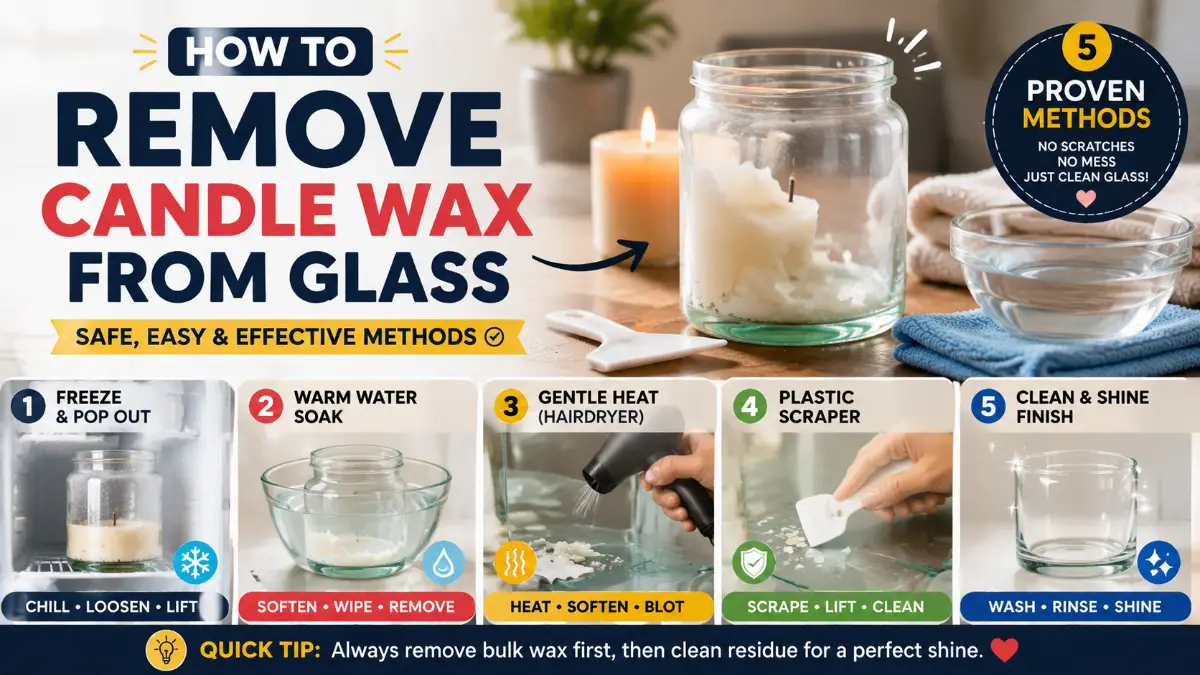
Learning how to remove candle wax from glass is usually easier than it looks. Whether wax is stuck inside an empty candle jar, hardened on a glass table, or splashed onto a window, the safest approach is to loosen the wax with cold or controlled warmth before trying to scrape it away. That reduces the chance of scratching the surface, spreading melted wax, or exposing the glass to an abrupt temperature change.
The best method depends on where the wax is, how thick it is, and whether the glass is plain, coated, decorated, curved, or heat-sensitive.
For most candle jars, start with the freezer method. For flat glass, gentle warming or careful scraping may work better. Once the solid wax is gone, warm water and dish soap can usually handle the remaining oily film.
How to Remove Candle Wax From Glass Safely
Before choosing a method, let the candle and glass cool completely. Avoid sudden temperature changes, especially with thin, chipped, cracked, antique, painted, or decorative glass.
The five most useful approaches are:
- Freezing for candle jars and thick deposits
- A warm-water bath for sturdy containers
- A hairdryer for fixed or flat glass
- A plastic scraper for loosened wax
- A glass scraper for suitable plain, flat glass
You may need more than one method. For example, freezing can remove the main wax plug, while dish soap and warm water finish the residue.
Quick Method Comparison
| Situation | Recommended Method | Main Advantage |
| Wax inside a candle jar | Freezer | Helps solid wax contract and release |
| Thick wax in a sturdy container | Warm-water bath | Softens wax gradually |
| Wax on a window or tabletop | Hairdryer | Works without moving the glass |
| Small loosened wax pieces | Plastic scraper | Low scratching risk |
| Hardened wax on plain flat glass | Approved glass scraper | Precise removal of stubborn deposits |
| Oily film after wax removal | Dish soap and warm water | Removes greasy residue |
Method 1: Use the Freezer for Candle Jars
The freezer method is one of the simplest ways to remove wax from a glass jar because cold makes the wax firmer and can help it pull away from the sides of the container. It is particularly useful when a candle has burned down and a solid layer of wax remains at the bottom.
Steps
- Make sure the candle jar has cooled fully to room temperature.
- Remove any loose debris from the jar.
- Place the jar upright in the freezer.
- Leave it until the remaining wax is thoroughly firm. Start checking after about an hour and give thicker deposits more time if necessary.
- Remove the jar and gently press or loosen the edge of the wax with a plastic utensil.
- Tip the jar over a protected work surface or trash bin.
- Lift out any remaining pieces without forcing them.
Do not place a warm candle jar directly into the freezer. Rapid temperature changes can stress glass. If the wax does not release easily, return the jar to the freezer rather than prying aggressively.
Also Read: Bonefish Grill: Menu, Locations, Happy Hour, and Everything You Need to Know
What About the Wick Holder?
Many candles have a metal wick tab attached to the bottom of the container. After the wax is removed, the tab may still remain. Do not attack it with a knife. If it does not lift with gentle pressure, soften any adhesive carefully with mild warmth and work it loose with a plastic tool.
Method 2: Use a Warm-Water Bath
A warm-water bath is helpful for thick candle wax that does not release cleanly when frozen. The goal is controlled warming, not extreme heat. Paraffin wax, one common candle material, is insoluble in water and typically melts within a range well above ordinary room temperature. Water therefore does not chemically dissolve the wax; warmth simply helps soften it so it can be lifted or wiped away.
Steps
- Let the glass reach room temperature.
- Fill a bowl or sink with warm-to-hot tap water.
- Stand the candle jar in the water.
- Keep water out of the jar if you want the wax to remain easier to collect.
- Allow the glass to warm gradually.
- Once the wax softens around the edges, loosen it with a plastic spoon or scraper.
- Remove the wax and wipe the jar with a paper towel while it is still slightly warm.
- Finish with dish soap and water.
Avoid pouring boiling water directly into a cold candle jar. Also avoid using this technique on glass that is cracked, unusually thin, hand-painted, or otherwise unsuitable for heating.
Do Not Pour Melted Wax Down the Drain
Wax can cool and solidify inside plumbing.
Collect softened wax with a paper towel, spoon, disposable container, or other suitable material and place it in the trash according to your local waste practices.
Method 3: Soften Wax With a Hairdryer
A hairdryer is often the most convenient option for how to get candle wax off glass when the surface cannot be placed in a freezer or water bath.
It works especially well for:
- Glass tabletops
- Windows
- Mirrors with plain glass areas
- Glass shelves
- Large candle containers
- Small wax drips on fixed surfaces
Steps
- Let the wax harden first so you can remove any thick pieces.
- Set the hairdryer to low or medium heat.
- Hold it several inches away from the wax.
- Keep the airflow moving instead of heating one spot continuously.
- When the wax begins to soften, blot it with a paper towel.
- Repeat until the bulk of the wax has been removed.
- Wash the remaining film with warm water and dish soap.
Blotting is usually better than wiping aggressively because wiping molten wax can spread it over a larger area. Do not use excessive heat on tinted, painted, laminated, coated, antique, cracked, or unknown glass surfaces.
Method 4: Lift Hardened Wax With a Plastic Scraper
For small wax deposits, temperature treatment may loosen the wax but leave a few pieces attached. A plastic scraper, plastic putty knife, old plastic card, silicone spatula, or similar nonmetal tool can help lift them without the concentrated sharp edge of a metal knife. This is one of the safest techniques for curved candle jars.
Steps
- Freeze or gently warm the wax first.
- Position the plastic edge underneath one side of the wax.
- Push slowly rather than digging downward.
- Lift the wax away in pieces.
- Repeat from another angle if necessary.
- Wash away the remaining film afterward.
Never use excessive force. If the wax refuses to move, repeat the cold or warming step. The objective is to make the wax release—not to scrape the glass clean through pressure alone.
Method 5: Use a Glass Scraper Only on Suitable Flat Glass
A purpose-made glass scraper or razor-style scraper can remove very stubborn wax from some plain, flat glass surfaces, but this method requires the most caution. It should not be your first choice for candle wax removal from glass.
Before using any blade or scraper, check the care instructions for the specific surface. Some coated, treated, tinted, decorative, mirrored, or specialty glass can be scratched or damaged even when the underlying glass itself appears smooth.
If the Surface Is Approved for Scraping
- Remove loose wax first.
- Work on a clean surface so trapped grit does not scratch the glass.
- Keep the scraper nearly flat rather than pointing the blade downward.
- Use light, controlled strokes.
- Stop immediately if the blade catches or the surface begins to mark.
- Wash the area when finished.
Never use a razor blade on curved candle jars simply because it worked on a window. Curved surfaces make it harder to maintain a safe angle and increase the chance of slipping or damaging the container.
How to Clean Candle Wax From Glass After the Solid Wax Is Gone
Removing the solid wax is only the first step. Candle wax can leave a greasy or cloudy film on the surface. For most ordinary glass, warm water and grease-cutting dish soap are the safest first choice.
Basic Residue-Cleaning Method
- Wipe away as much wax as possible with a paper towel.
- Wash the glass with warm water and dish soap.
- Use a soft sponge or microfiber cloth.
- Rinse thoroughly.
- Dry with a lint-free cloth.
Repeat the wash if necessary. This simple process is usually preferable to reaching immediately for strong solvents.
Can Rubbing Alcohol Help?
Rubbing alcohol can sometimes help with light oily residue or other grime left after the bulk wax has been removed, but it should not be treated as the primary solvent for solid candle wax. Paraffin is a hydrocarbon wax and is insoluble in water; its documented solubility is associated with particular organic solvents rather than ordinary water-based cleaning.
If you use rubbing alcohol as a finishing cleaner, first confirm that the glass is uncoated and that surrounding paint, labels, adhesives, finishes, or decorations will not be affected. Keep alcohol away from flames and heat sources.
How to Remove Melted Wax From Glass
If wax has just spilled, resist the temptation to smear it around while it is still liquid.
Instead:
- Keep people and pets away from the hot wax.
- Let it cool until it becomes firm.
- Lift away the thickest portion.
- Use cold, a hairdryer, or a suitable scraper depending on the surface.
- Wash away the final residue.
Allowing the wax to solidify first often makes cleanup much easier because a large portion can be removed as one piece rather than spread into a thin coating.
How to Remove Candle Residue From Glass Without Scratching It
The key to scratch prevention is reducing mechanical force.
Use this order:
- Let the wax cool.
- Loosen it with cold or controlled warmth.
- Lift it with a plastic tool.
- Use a scraper only if the specific flat-glass surface permits it.
- Finish with soap and water.
Avoid steel wool, abrasive powders, rough scouring pads, knives, and improvised metal tools. Even if a material is harder than wax, it does not mean it is appropriate for every glass finish.
What About Vinegar?
White vinegar is useful for many household cleaning jobs, particularly some mineral deposits and general surface grime, but it is not the most useful tool for removing a thick layer of candle wax. If solid wax remains, deal with the wax physically through cooling, warming, and gentle lifting first. Vinegar can be reserved for a later cleaning step when appropriate for the surface.
What About Acetone?
Strong solvents are unnecessary for most candle-wax cleanup. Acetone may also affect paint, printed decorations, adhesives, coatings, plastics, sealants, nearby finishes, and other materials around a candle container. For ordinary household cleanup, freezing, gentle heat, plastic scraping, dish soap, and careful glass scraping where permitted provide a more controlled approach.
Common Mistakes to Avoid
Knowing how to remove candle wax from glass safely is as much about avoiding the wrong techniques as choosing the right one.
Using Extreme Temperature Changes
Do not move warm glass directly into a freezer or pour very hot water into cold glass. Gradual temperature changes are safer.
Scraping Before Loosening the Wax
Hard scraping creates unnecessary pressure. Use cold or warmth first so the wax releases more easily.
Using Metal Knives on Candle Jars
Kitchen knives are difficult to control on curved surfaces and can damage the jar or injure your hand. Use plastic tools instead.
Pouring Wax Into the Sink
Never intentionally wash chunks or pools of melted candle wax down a drain. Collect the wax and dispose of it as solid waste.
Heating Decorative Glass Without Checking It
Painted, tinted, frosted, glued, laminated, antique, and coated surfaces may respond differently to heat and cleaning products. When the finish is uncertain, choose the least aggressive technique.
How to Clean an Empty Candle Jar for Reuse
If your goal is to clean an empty candle jar, begin with the freezer method and then remove the wick tab or other loose candle components.
After that:
- Remove all solid wax.
- Wipe out greasy residue.
- Wash the container with dish soap and warm water.
- Rinse thoroughly.
- Let it dry completely.
- Inspect the glass for cracks, chips, loosened decorations, or other damage.
A cleaned candle jar can often be repurposed for non-food household storage, craft supplies, small objects, or decorative use. Be cautious about automatically turning a used container into another candle. Candle containers experience repeated heating during use, and not every decorative jar is intended to be refilled and reheated. If you want to make a new candle, use a container specifically suitable for candle making.
Which Method Should You Try First?
For a typical candle jar, the safest sequence is:
Freeze → lift with plastic → wash with dish soap.
For wax on a fixed pane or glass table:
Harden → lift thick pieces → soften remaining wax gently → blot → wash.
For stubborn wax on plain flat glass:
Loosen first → use an approved glass scraper only if appropriate → wash.
This sequence minimizes unnecessary scraping while still giving you several ways to handle difficult residue.
Frequently Asked Questions
What is the easiest way to remove candle wax from a glass jar?
For most candle jars, freezing is the easiest starting point. Let the jar cool completely, place it in the freezer, then gently loosen the hardened wax with a plastic tool once it has contracted.
How long should a candle jar stay in the freezer?
There is no universal time because jar size and wax thickness vary. Start checking after about an hour. Thick wax may need longer. The wax is ready when it becomes firm and begins releasing from the glass without force.
Can boiling water break a candle jar?
A sudden temperature change can stress glass. Avoid pouring boiling water directly into a cool or cold candle jar. Gradual warming with warm-to-hot tap water is a more cautious approach.
Can I use a knife to remove candle wax?
A kitchen knife is not recommended, particularly inside curved jars. A plastic scraper or similar blunt plastic tool provides better control and lowers the risk of scratching the glass or cutting yourself.
Does vinegar dissolve candle wax?
Vinegar is not an efficient way to remove a thick layer of candle wax. Remove the wax through freezing, controlled warming, or gentle scraping first, then use an appropriate cleaner for the remaining surface residue.
Can rubbing alcohol remove wax from glass?
Rubbing alcohol may help clean a light residual film on suitable uncoated glass, but it is better considered a finishing cleaner than the primary way to remove solid candle wax. Keep it away from heat and flames.
How do I remove candle wax from a glass table?
Let the wax harden, lift away thick pieces with a plastic scraper, then use a hairdryer on low or medium heat to soften the thin remainder. Blot it and finish with dish soap and water.
Can I pour melted candle wax down the sink?
No. Wax can cool and harden inside drains. Collect wax with paper towel or another disposable material and place the solid material in the trash rather than washing it into plumbing.
Can I reuse a candle jar after cleaning it?
A clean, undamaged jar can often be repurposed for household storage or decorative uses. Refilling it with another candle requires more caution because not every used or decorative glass container is suitable for repeated candle heating.
What is the safest overall method for getting candle wax off glass?
For ordinary candle jars, freezing followed by gentle lifting with a plastic tool is usually the least aggressive option. For fixed flat glass, controlled warming with a hairdryer can be more practical. Always match the method to the type and finish of the glass.