
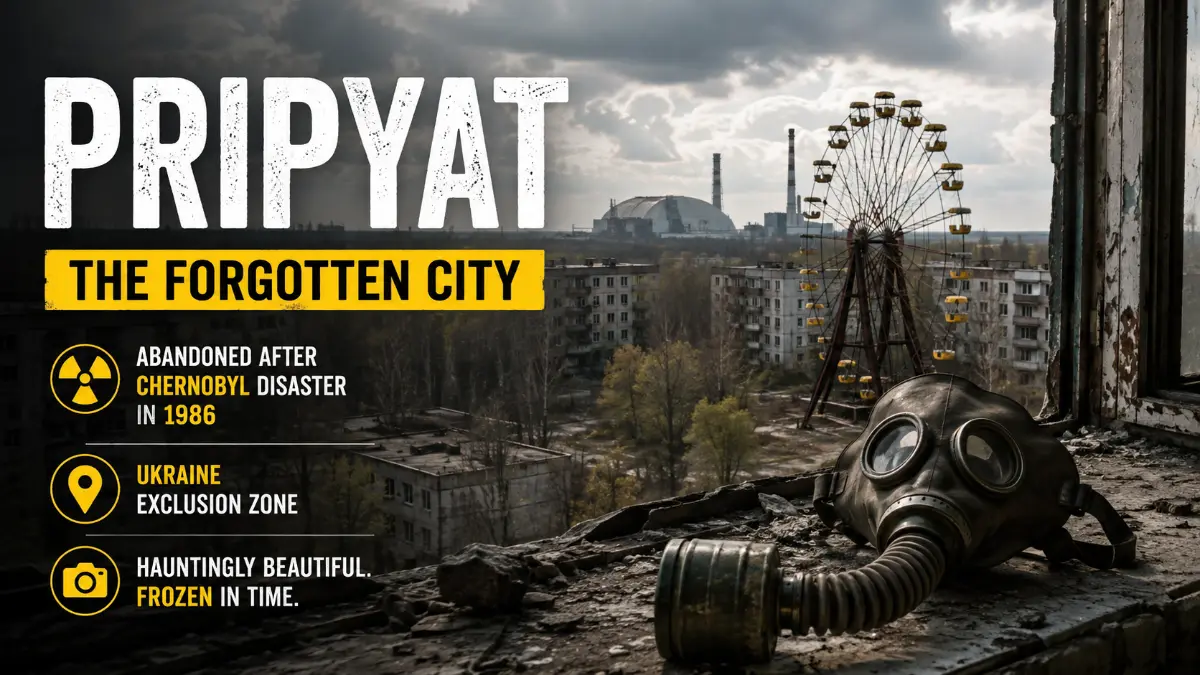
Pripyat was once a young Soviet city built around nuclear power, modern housing, schools, recreation, and an expanding workforce. Everything changed after the April 26, 1986 disaster at the nearby Chernobyl Nuclear Power Plant. The city was evacuated the following afternoon and never returned to normal residential life. Today, its empty apartment blocks, public buildings, amusement park, and overgrown streets have made it one of the world’s best-known abandoned cities.
Its story, however, is more important than the haunting photographs usually associated with it. Understanding this place means looking at why it was built, what everyday life was like, what happened during the evacuation, how it differs from Chernobyl itself, and why the surrounding Exclusion Zone remains a controlled and historically sensitive landscape.
What Is Pripyat?
Pripyat Ukraine was created as a purpose-built community for employees of the nearby Chernobyl Nuclear Power Plant and their families. Founded in 1970, it belonged to a generation of Soviet planned settlements associated with major industrial and scientific projects. It developed rapidly because the nuclear power station needed engineers, technicians, construction workers, administrators, and supporting services. By 1986, the city’s population was approaching 50,000.
Unlike the image of decay associated with it today, the original city was designed as a functioning modern community. Residents had apartment buildings, schools, shops, sports facilities, cultural venues, medical services, public transport, and recreational spaces.
The city’s population was also unusually young. Historical accounts describe an average age of roughly 26, reflecting the large number of young workers and families drawn to the nuclear project. Historical inventories record numerous schools, stores, cafés, sports facilities, swimming pools, and other amenities. That contrast is central to understanding the city’s history. It was not built as an isolated settlement destined for decline. It was designed to grow.
The History of Pripyat Before the Chernobyl Disaster
Before becoming synonymous with nuclear catastrophe, the city represented an optimistic vision of Soviet technological development. Construction began as the Chernobyl Nuclear Power Plant itself expanded. Large residential districts were created using the standardized apartment-building designs common throughout the Soviet Union, while schools, shops, recreational facilities, and civic buildings were added as the population increased.
The Palace of Culture Energetik became one of the principal community spaces. Like similar Soviet cultural centers, it combined entertainment, recreation, meetings, performances, sports, and other community activities. The city also included swimming pools, stadiums, a hospital, supermarkets, cafés, a cinema, playgrounds, and extensive residential districts. Archival accounts portray a growing city whose infrastructure was still being expanded in 1986.
One of its most recognizable landmarks was still unfinished as a public attraction: the amusement park near the center of the city. Its Ferris wheel would later become an international symbol of the disaster. This makes the pre-1986 history particularly important. The ruins seen today were not the remains of a declining settlement. They were part of a relatively new city that expected a future.
Also Read: Urbex Meaning: What Urban Exploration Really Means
What Happened at Chernobyl in April 1986?
During the early hours of April 26, 1986, Reactor No. 4 at the Chernobyl Nuclear Power Plant was destroyed during a test involving the reactor and its electrical systems. The accident released radioactive material into the environment and triggered an enormous emergency response involving plant employees, firefighters, government agencies, military personnel, engineers, scientists, and later hundreds of thousands of people involved in cleanup and containment efforts.
Official Chornobyl Nuclear Power Plant records place the accident at Unit 4 at approximately 1:23 a.m. on April 26. The evacuation of the nearby city did not begin immediately. Radiation conditions were monitored during April 26. By that evening, radiation levels had increased significantly enough that Soviet authorities began preparing to evacuate residents. Buses and special trains were brought into the area during the night.
For residents, that delay meant that much of the first day after the explosion unfolded without a full public understanding of what had happened.
How the Pripyat Evacuation Happened
The evacuation began at approximately 2 p.m. on April 27, 1986. Official Chornobyl NPP records state that it took about three hours and that approximately 45,000 people were transported from the city that day. The evacuation effort involved a huge fleet of buses as well as railway transport prepared during the previous night.
Residents were instructed to take identification, necessary personal items, food for a short period, and limited belongings. The evacuation was presented as temporary, which meant people left most of their possessions behind.
They did not return to resume normal life. That fact is one reason the abandoned city became so powerful in popular memory. Unlike ancient ruins that deteriorated gradually, this was a modern community emptied as a direct consequence of an industrial catastrophe. Homes, classrooms, civic buildings, shops, and recreation facilities remained inside an increasingly controlled radioactive zone.
How Many People Were Evacuated?
Different figures are sometimes presented because sources may refer either to the population of the city immediately before the accident or to the number physically transported during the April 27 evacuation.
Official Chornobyl NPP documentation reports that about 45,000 people were evacuated from the city on April 27. By the end of 1986, approximately 116,000 people had been resettled from 188 settlements affected by the disaster. This distinction is more accurate than treating every commonly cited population figure as the number transported during the initial evacuation.
Where Did the Evacuated Residents Go?
The residents did not all move directly into one replacement city. In the immediate aftermath, displaced families were accommodated in communities outside the most contaminated areas. Historical documentation describes families staying in locations such as Polesskoe and later receiving housing elsewhere, including Kyiv.
Slavutych was subsequently constructed as a new city for personnel connected with the Chernobyl Nuclear Power Plant and their families. It became closely associated with the displaced plant workforce, but it is misleading to say that the entire former population simply moved there together.
The distinction also reveals an important part of the Chernobyl story: evacuation, permanent resettlement, construction of Slavutych, and continued operation of the remaining reactors were separate stages rather than a single event.
Pripyat vs Chernobyl: Are They the Same Place?
No. The names are closely connected, but they refer to different places.
Pripyat was the purpose-built residential city for the nuclear plant workforce. Chernobyl, or Chornobyl in Ukrainian transliteration, is the name associated with both the nuclear power station and a separate historic town in the region.
The abandoned city was much closer to the nuclear plant and had a considerably larger population immediately before the accident than the town of Chernobyl. This distinction is useful because popular culture frequently uses “Chernobyl” as a general label for the reactor, disaster, Exclusion Zone, and nearby abandoned urban landscape.
Read More: Osprey Farpoint 40 Review: The Ultimate Carry-On Travel Backpack Guide
Why Was the Chernobyl Exclusion Zone Created?
The disaster contaminated territory in Ukraine and neighboring regions with radioactive material. Authorities progressively evacuated areas surrounding the reactor and established restrictions on where people could live.
On May 2, 1986, Soviet authorities decided to evacuate additional populations from the 30-kilometer area around the nuclear power plant and other contaminated settlements. By the end of that year, about 116,000 people had been evacuated or resettled from affected communities.
The modern Exclusion Zone is not simply an abandoned tourist attraction. It is a controlled territory associated with radioactive contamination, nuclear decommissioning, environmental research, waste management, security, and continuing work at the Chornobyl site. Radiation is also not distributed uniformly. Conditions vary significantly by location, which is one reason informal exploration should never be treated as equivalent to ordinary urban sightseeing.
What Happened to the Nuclear Plant After 1986?
One of the most surprising facts about the history of Pripyat Chernobyl is that the nuclear power plant did not stop operating permanently when the neighboring city was evacuated. Other units continued generating electricity after the accident.
The Chornobyl Nuclear Power Plant officially stopped electricity generation on December 15, 2000, when Unit 3 was permanently shut down. The plant reports that it generated substantial electricity between 1986 and the final shutdown.
This creates a striking historical contrast: the residential city remained abandoned while a major industrial operation continued only a few kilometers away. Today, work at the nuclear site focuses on decommissioning, radioactive-waste management, nuclear safety, and related technical activities rather than electricity production.
Famous Landmarks of the Pripyat Abandoned City
Several places have come to represent the abandoned city in photography, documentaries, books, games, and television.
Because ordinary tourism to the Chornobyl zone remains restricted under wartime conditions, these should be understood as historically significant locations rather than a current self-guided travel itinerary. Ukrainian tourism guidance has stated that the Chornobyl zone remains closed to ordinary visitors.
The Ferris Wheel and Amusement Park
The yellow Ferris wheel is probably the most recognizable structure in the city.
The amusement park was intended to become part of the city’s recreational life around the May Day period in 1986, but the disaster prevented its planned public future. Today, the Ferris wheel, bumper cars, and other deteriorating structures have become visual symbols of interrupted everyday life.
Palace of Culture Energetik
The Palace of Culture Energetik stood at the heart of the community. It included spaces associated with performances, recreation, meetings, sports, and cultural activities. Its scale helps modern observers understand that this was a fully developed urban community rather than simply housing attached to an industrial site.
Azure Swimming Pool
The Azure, or Lazurny, swimming pool is another well-known location. Unlike many buildings emptied in 1986, the swimming complex reportedly remained in use for years afterward by people working in the zone before eventually being abandoned. Its empty pool, diving platforms, damaged windows, and gymnasium later became some of the city’s most widely photographed interiors.
Schools and Kindergartens
Educational buildings are among the most emotionally powerful remains. The city had numerous educational facilities serving its young population. Empty classrooms and decaying school buildings emphasize the scale of the community that disappeared after the evacuation.
However, photographs of staged dolls, gas masks, or carefully arranged personal objects should not automatically be interpreted as scenes preserved exactly as residents left them. Decades of cleanup work, unauthorized entry, tourism, deterioration, and deliberate rearrangement have altered many interiors.
Apartment Blocks and Central Square
High-rise apartment buildings dominate the skyline. Vegetation has gradually obscured roads, courtyards, playgrounds, and sightlines that once made the city feel open and modern. The contrast between standardized concrete architecture and uncontrolled forest growth is now one of its defining visual characteristics.
Central public spaces also include the Polissya Hotel and other civic structures associated with everyday Soviet urban life.
How Nature Has Changed the Ghost Town
The term Pripyat ghost town can create the impression that nothing has changed since April 1986. In reality, the physical environment has changed continuously. Trees and shrubs have spread across former lawns, roadside areas, playgrounds, and open spaces. Water damage, freezing and thawing, corrosion, collapsing roofs, broken windows, and decades without ordinary maintenance have weakened buildings.
The city is therefore not a perfectly preserved time capsule. It is better understood as a landscape where traces of 1986 coexist with four decades of weathering, cleanup operations, vegetation growth, human intrusion, and structural decay. That difference matters for both historical accuracy and responsible interpretation.
Can You Visit Pripyat in 2026?
For ordinary travelers, the answer is effectively no under current wartime restrictions.
Ukraine’s State Agency for Tourism Development has stated that the Chornobyl zone remains closed to visitors during wartime conditions. The wider region also faces security restrictions associated with forests, border areas, strategic infrastructure, and territories affected by occupation or military activity.
That does not mean nobody can enter the zone.
Official visits still occur in controlled circumstances. For example, international officials and delegations visited the Chornobyl NPP and Exclusion Zone in May 2026. The plant also publishes procedures covering authorized technical delegations and media visits.
Travelers should therefore distinguish ordinary commercial tourism from authorized official, professional, or technical access. Entering restricted areas without permission is neither a legitimate alternative nor a safe form of urban exploration.
Why Pripyat Still Matters
The significance of this place extends far beyond abandoned-building photography.
It preserves evidence of several interconnected histories:
- Soviet nuclear-energy development
- planned urban design
- everyday life in a late-Soviet industrial city
- the Chernobyl nuclear disaster
- mass evacuation and displacement
- radioactive contamination
- nuclear cleanup and decommissioning
- the transformation of human environments after abandonment
- changing public attitudes toward nuclear safety
- the effects of Russia’s war against Ukraine on the Exclusion Zone
It is especially powerful because its history contains such a sharp division between “before” and “after.”
A city created around technological confidence became a global symbol of technological failure. Homes designed for permanent family life became restricted ruins. Recreational facilities intended for a growing population became historical artifacts. Yet reducing the city to an eerie backdrop misses its most important lesson: before becoming ruins, these buildings belonged to real people.
Key Facts at a Glance
| Detail | Information |
| Country | Ukraine |
| Founded | 1970 |
| Purpose | Residential city serving the nearby Chernobyl Nuclear Power Plant |
| Population before the disaster | Nearly 50,000 |
| Reactor 4 disaster | April 26, 1986 |
| City evacuation | April 27, 1986 |
| Approximate residents evacuated that day | About 45,000 |
| Evacuation duration | About 3 hours |
| Wider 1986 resettlement | About 116,000 people from 188 settlements |
| Final Chornobyl reactor shutdown | December 15, 2000 |
| Present character | Abandoned city within a controlled exclusion area |
| Ordinary tourism in 2026 | Closed under current wartime restrictions |
| Special authorized access | Possible in controlled official circumstances |
Frequently Asked Questions
Why is Pripyat abandoned?
The city was evacuated after the April 26, 1986 accident at Reactor No. 4 of the nearby Chernobyl Nuclear Power Plant. Radioactive contamination and the subsequent creation of exclusion and resettlement areas prevented the population from returning to normal permanent residence.
When was Pripyat evacuated?
The evacuation began at approximately 2 p.m. on April 27, 1986, the day after the reactor accident. Official Chornobyl NPP records state that the operation took roughly three hours.
How many people lived there before Chernobyl?
The population was approaching 50,000 before the disaster. Official records concerning the evacuation state that approximately 45,000 people were transported from the city on April 27.
Is Pripyat the same as Chernobyl?
No. It was a residential city built for nuclear plant employees and their families. Chernobyl is also the name of a separate town, while the Chernobyl Nuclear Power Plant was the industrial site where Reactor No. 4 was destroyed.
What happened to the people who lived there?
Residents were evacuated to settlements outside the immediate contaminated area and later permanently resettled. Some received housing in Kyiv and other communities. Slavutych was subsequently constructed for personnel associated with the nuclear plant and their families.
Is Pripyat still radioactive?
Radioactive contamination remains part of the Exclusion Zone’s management, but radiation is not uniform across every street or building. Levels vary by location and environmental conditions, which is why access is regulated and radiation protection remains relevant.
What are the most famous places in Pripyat?
The best-known landmarks include the amusement park and Ferris wheel, Palace of Culture Energetik, Azure swimming pool, schools, apartment blocks, central public buildings, and the Polissya Hotel. They are primarily significant today as historical remains rather than conventional tourist attractions.
Can tourists visit Pripyat in 2026?
Ordinary tourism is not currently operating as it did before Russia’s full-scale invasion. Ukrainian tourism guidance continues to list the Chornobyl zone as closed to visitors, although official delegations and other specially authorized visits can take place.
Did the Chernobyl Nuclear Power Plant close immediately after the accident?
No. Other reactors continued operating after 1986. The Chornobyl NPP officially stopped generating electricity on December 15, 2000, when Unit 3 was permanently shut down.
Will the city ever be inhabited again?
There is no established plan to restore it as an ordinary residential city. Radioactive contamination, its location within the Exclusion Zone, deteriorating infrastructure, structural damage, and current security conditions all make large-scale permanent resettlement unrealistic under present circumstances.