
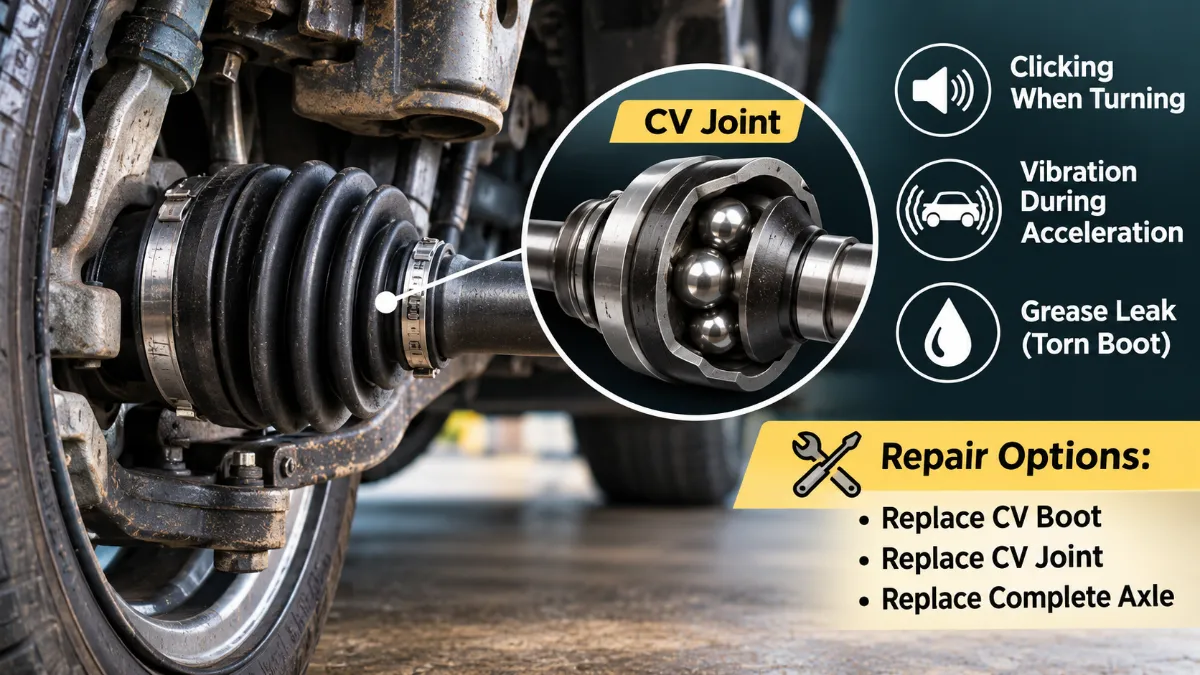
A CV joint (constant velocity joint) is a drivetrain component that transfers rotational power from the transmission or differential to a vehicle’s driven wheels while allowing for steering and suspension movement. CV joints are commonly found in front-wheel-drive (FWD) and all-wheel-drive (AWD) vehicles, as well as some rear-wheel-drive (RWD) designs.
When a CV joint starts wearing out, you might notice clicking or popping during turns, vibration when accelerating, clunking, or grease leaking around the axle. The right repair depends on the extent of the damage. A torn protective boot can sometimes be replaced on its own, but a worn joint may require replacing the joint or the complete axle assembly.
What Is a CV Joint and How Does It Work?
A CV joint keeps power flowing smoothly to the wheels even as the angle of the axle changes. This flexibility is especially important when you turn the steering wheel or drive over bumps and uneven roads.
Most conventional FWD CV axle assemblies have an inner joint, an outer joint, an axle shaft, and protective rubber or thermoplastic boots. Each component helps the drivetrain accommodate movement while transferring power.
Inner vs. Outer CV Joints
| Component | Location and Function | Common Failure Symptom |
| Inner CV joint | Near the transmission or differential; accommodates suspension movement and changes in axle length | Vibration during acceleration |
| Outer CV joint | Near the wheel hub; accommodates steering angles and suspension movement | Clicking or popping during turns |
| CV boot | Flexible cover around each joint; retains grease and keeps contaminants out | Visible tears or grease leakage |
CV joint vs. CV axle: A CV joint is just one part of a complete CV axle assembly. The assembly includes the axle shaft, inner and outer joints, protective boots, and related hardware.
What Are the Symptoms of a Bad CV Joint?
The most common symptoms of a bad CV joint are unusual noises, vibration, and visible damage to the protective boots. According to CV axle troubleshooting guidance, the type of symptom can help narrow down which joint may be causing the problem.
- Clicking or popping when turning: A worn outer CV joint often makes repeated clicking sounds during sharp, low-speed turns. The noise may become more noticeable as the damage progresses.
- Vibration during acceleration: A worn inner joint can cause shaking when you press the accelerator. The vibration may ease when you release the pedal.
- Clunking noises: Excessive joint wear can produce clunks when accelerating, slowing down, or shifting between drive and reverse.
- Grease around the wheel: Grease splattered inside a wheel or across nearby suspension components may indicate a torn CV boot or loose clamp.
- Cracked or torn boots: A damaged boot allows grease to escape while dirt and moisture enter the joint, increasing the risk of wear.
These warning signs don’t automatically mean a CV joint has failed. Worn wheel bearings can produce humming or grinding noises, unbalanced tires may cause vibration at certain speeds, and suspension or engine-mount problems can create similar symptoms.
What Causes CV Joints to Go Bad?
CV joints handle constant movement and mechanical stress. Although they’re designed to last for years, several factors can shorten their service life:
- Torn CV boots: Cracks, splits, or loose clamps allow lubricating grease to escape.
- Lubricant loss: Without enough grease, friction increases and the joint wears more quickly.
- Dirt and moisture contamination: Debris entering through a damaged boot can damage the joint’s internal surfaces.
- Age and repeated loading: Years of use gradually wear internal components, particularly when lubrication deteriorates.
- Impact or abnormal operating conditions: Suspension damage, incorrect axle geometry, or excessive joint angles can place additional stress on the joint.
A torn boot doesn’t necessarily mean the joint is ruined. If the damage is caught early and the joint remains clean and free of excessive wear, replacing the boot may be enough. However, once contamination or significant internal wear develops, replacing the joint or axle is usually the more reliable solution.
How Is a Bad CV Joint Diagnosed?
A mechanic usually starts with a visual inspection, then checks for mechanical wear and may perform a controlled road test.
During the inspection, the mechanic looks for cracked boots, loose clamps, leaking grease, and excessive movement or binding in the joint. A road test can help identify when noises or vibrations occur.
For example, repeated clicking during tight turns often points toward an outer CV joint, while shaking under acceleration may suggest an inner-joint problem. The mechanic should also check other possible causes before recommending replacement.
Can a CV Joint Be Repaired, or Does It Need Replacement?
Whether CV joint repair is possible depends on the condition of the joint itself.
If a torn boot is discovered before the joint suffers damage, replacing the boot and restoring proper lubrication may be enough to keep the original joint in service.
However, a joint that has developed significant wear, binding, or persistent noise generally needs replacement. Simply installing a new boot won’t repair worn internal components.
CV Boot Repair vs. CV Joint Replacement
There are three main repair options:
- CV boot replacement: Suitable when the protective boot is damaged, but the joint is still clean and mechanically sound.
- Individual CV joint replacement: Possible on certain vehicles when compatible replacement joints are available, and the manufacturer supports separate servicing.
- Complete CV axle replacement: Replaces the axle shaft, joints, and boots together. This is often the more practical choice because the new assembly comes ready to install. When selecting replacement components, check vehicle compatibility, part quality, and warranty coverage. Our guide to Detroit Axle replacement parts provides additional information about aftermarket automotive parts and buying considerations.
The best option depends on the condition of the CV boot and axle assembly, the vehicle’s design, and the cost of parts and labor.
You also don’t automatically need to replace both CV axles at the same time. Each axle should be inspected separately, and a properly functioning assembly can generally stay in place.
How Much Does CV Joint Replacement Cost?
The CV joint replacement cost in the United States depends on the vehicle, the type of repair needed, replacement parts, and local labor rates.
The following published national repair estimates were updated in September 2026. They provide useful pricing benchmarks, although your actual repair quote may be higher or lower.
| Repair Type | Parts Cost | Labor Cost | Total Estimated Cost |
| CV boot replacement | 159–160 | 251–369 | 411–528 |
| CV joint replacement | About $1,082 | 227–333 | 1,309–1,414 |
| Complete CV axle replacement | 1,075–1,076 | 208–306 | 1,283–1,381 |
These estimates reflect published figures for CV boot replacement, CV joint replacement, and complete CV axle replacement.
The amounts exclude taxes, fees, regional price differences, and additional repairs. Also, a CV joint replacement estimate may cover more than replacing one individual joint, so the listed price shouldn’t be treated as a universal joint-only cost.
Your final bill will depend on the vehicle’s make and model, drivetrain configuration, original-equipment versus aftermarket parts, and the shop’s labor rates.
Before approving repairs, ask for a written estimate that separates parts and labor. If the joint itself is still in good condition, it’s worth asking whether a boot replacement could save the cost of a complete axle assembly.
Is It Safe to Drive With a Bad CV Joint?
Driving with a failing CV joint can be risky, especially when the joint is already making loud noises or causing noticeable vibration.
If a joint fails, the affected wheel can lose drive torque. Depending on the vehicle’s drivetrain, this may leave the car unable to move under its own power. However, CV joint failure doesn’t automatically mean the driver will lose steering control.
A small tear in a CV boot may not immediately affect how the vehicle drives, but it should still be inspected promptly. Continuing to drive with heavy clunking, pronounced vibration, or binding can make the damage worse.
If the vehicle becomes difficult to control, develops severe symptoms, or suddenly loses drive power, pull over somewhere safe and arrange professional assistance or towing.
There’s no dependable way to predict how many miles a damaged CV joint will last. The safest approach is to have the problem checked before it becomes more serious.
How to Help CV Joints Last Longer
CV joints can last many years, sometimes for much of a vehicle’s service life. There’s no universal replacement mileage, though, because longevity depends on operating conditions, maintenance, and the condition of the protective boots.
A few simple habits can help reduce premature wear:
- Have the CV boots checked during routine vehicle maintenance.
- Get cracked boots and grease leaks inspected before contamination causes damage.
- Don’t ignore new clicking noises, vibration, or clunking.
- Address suspension problems that put unnecessary stress on the axle joints.
Catching a damaged boot early gives you a better chance of saving the joint and avoiding a more expensive replacement.
Frequently Asked Questions
Can a CV Joint Fail Without Making a Clicking Noise?
Yes. Not every failing CV joint makes a clicking sound. Worn outer joints commonly click during turns, but inner-joint problems may show up as vibration during acceleration instead. Some joints also wear gradually without obvious noise until the damage becomes more serious.
What Is the Difference Between a CV Joint and a U-Joint?
Both components transfer rotational power between parts operating at an angle, but they handle that movement differently. A conventional single universal joint (U-joint) produces variations in rotational speed when working at an angle, while a CV joint is designed to maintain constant rotational speed. U-joints are commonly used in driveshafts, whereas CV joints are especially useful where steering and suspension movement cause the axle angle to change.