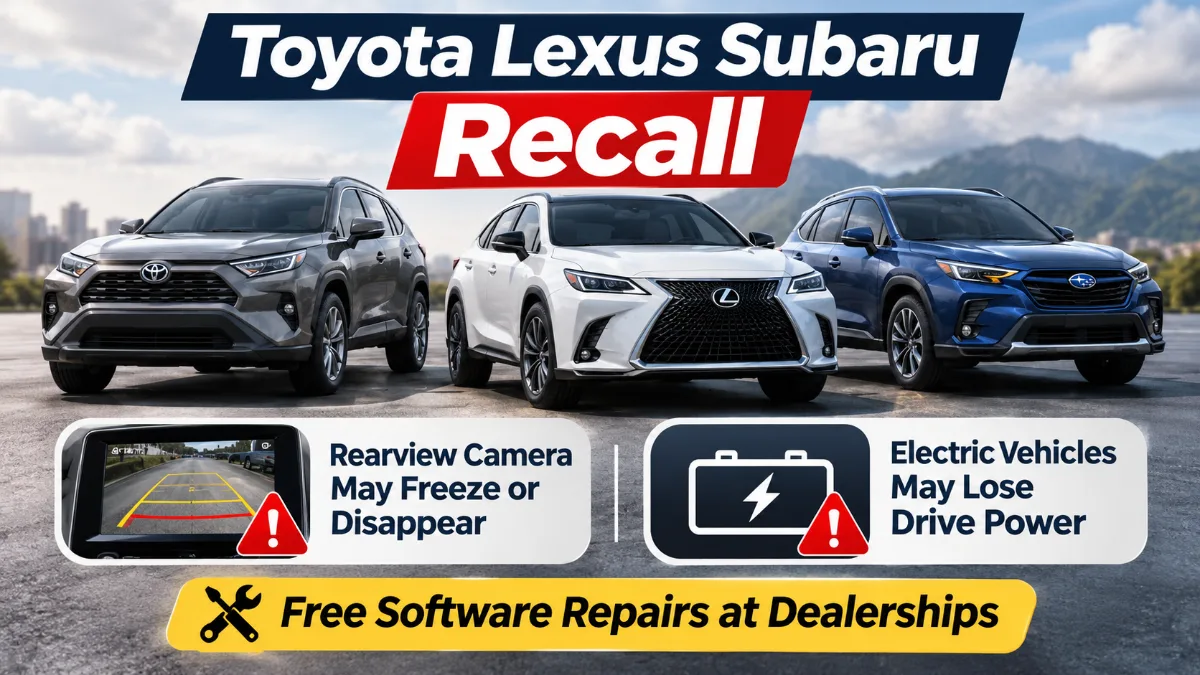
The Toyota Lexus Subaru recall involves two major U.S. safety campaigns affecting different vehicle systems. The October 2025 recall covers 1,024,407 potentially affected Toyota, Lexus, and Subaru vehicles because their rearview camera images may freeze or disappear. A separate June 2026 recall involves 20,991 electric vehicles that could unexpectedly lose drive power. Both campaigns provide free software repairs through authorized dealerships.
According to the official recall documents, the campaigns are identified by National Highway Traffic Safety Administration (NHTSA) numbers 25V744 and 26V393. However, not every vehicle within the listed model years is affected. Owners should check their 17-character Vehicle Identification Number (VIN) to confirm whether their vehicle requires a repair.
Which Toyota, Lexus and Subaru Vehicles Are Recalled?
The two campaigns involve different vehicle groups. The 2025 rearview camera recall includes certain gasoline, hybrid, plug-in hybrid, and electric vehicles. The 2026 recall specifically affects battery-electric SUVs.
| Recall details | 2025 rearview camera recall | 2026 electric vehicle recall |
| NHTSA campaign | 25V744 | 26V393 |
| Report date | October 30, 2025 | June 18, 2026 |
| Potentially affected vehicles | 1,024,407 | 20,991 |
| Toyota | Certain 2023–2026 models | 2026 bZ |
| Lexus | Certain 2022–2026 models | 2026 RZ |
| Subaru | 2023–2025 Solterra | 2026 Solterra |
| Defect | Rearview image may freeze or disappear | Unexpected loss of drive power |
| Free remedy | Parking Assist ECU software update | High-voltage battery ECU software update |
Models Included in the 2025 Rearview Camera Recall
The 2025 campaign includes certain vehicles equipped with the affected Panoramic View Monitor system. The official NHTSA safety recall report identifies the following model families and years.
Toyota models include:
- Camry Hybrid (2025–2026)
- Crown (2023–2026) and Crown Signia (2025)
- Grand Highlander and Grand Highlander Hybrid (2024–2026)
- Highlander and Highlander Hybrid (2023–2025)
- RAV4 and RAV4 Hybrid (2023–2025), including certain plug-in hybrid variants
- Prius (2023–2025), including certain plug-in hybrid variants
- bZ4X (2023–2025)
- Mirai (2023–2025)
- Venza Hybrid (2023–2024)
- Land Cruiser (2024–2025)
- Sienna Hybrid (2025)
Lexus models include:
- NX (2022–2025), including specified electrified variants
- RX (2023–2026), including specified electrified variants
- RZ (2023–2025)
- ES (2023–2025), including hybrid versions
- GX (2024–2025)
- LC (2024–2025), including hybrid versions
- LS (2023–2025), including hybrid versions
- LX (2022–2025), including the 2025 LX Hybrid
- TX (2024–2026), including specified electrified variants
Subaru models include:
– Solterra (2023–2025)
These model-year ranges are not a guarantee that every vehicle is recalled. Eligibility depends on production dates, installed equipment, and the vehicle’s individual VIN record.
Models Included in the 2026 Electric Vehicle Recall
The Toyota Lexus Subaru recall 2026 campaign covers certain 2026 Toyota bZ, Lexus RZ, and Subaru Solterra electric SUVs.
A total of 20,991 vehicles are potentially affected across these three model lines. Unlike the broader 2025 campaign, this recall concerns an electronic control fault in the high-voltage battery system.
Owners should verify their VIN rather than assuming that every 2026 vehicle in these model lines needs the update.
What Is Wrong With the Recalled Vehicles?
Although both recalls involve software-related defects, they affect different systems and create different safety concerns.
2025 Rearview Camera Software Problem
The 2025 recall involves the Parking Assist Electronic Control Unit (ECU), which supports the Panoramic View Monitor system.
Under certain conditions, a software error can cause the rearview camera image to freeze or show a blank screen when the driver shifts into reverse.
This makes it harder to see pedestrians, objects, or other vehicles behind the car. The defect also means affected vehicles may not comply with Federal Motor Vehicle Safety Standard No. 111, which establishes rear visibility requirements.
The prescribed repair is a free Parking Assist ECU software update performed by an authorized dealership.
2026 High-Voltage Battery Control Problem
The 2026 recall concerns the ECU responsible for controlling the high-voltage battery in certain electric vehicles.
If the control unit experiences a fault, the vehicle may unexpectedly lose drive power while moving. Losing propulsion in traffic can increase the risk of a collision, particularly when merging or crossing intersections.
This is an electronic control problem, not the same as a mechanical drivetrain issue involving a CV joint, which transfers power through the axle assembly.
The manufacturer has specified a free high-voltage battery ECU software update to address the recalled defect.
How Serious Are the Safety Risks?
Both problems can increase crash risk, although their effects on driving are different.
Rearview camera malfunction: A frozen or blank display can make backing up more dangerous, especially in crowded parking lots, residential driveways, and areas where pedestrians may be present. Until the update is completed, drivers should check their surroundings directly, use their mirrors, and reverse carefully rather than depending entirely on the camera.
Unexpected loss of drive power: An affected electric vehicle could lose propulsion while traveling, creating a potentially dangerous situation in moving traffic.
Neither campaign establishes a blanket stop-driving instruction for every affected vehicle. Still, owners should arrange the required repair promptly and follow any additional safety instructions issued by the manufacturer.
If an electric vehicle unexpectedly loses drive power, the driver should attempt to move toward a safe stopping location, switch on the hazard lights, and request roadside assistance when necessary.
How to Check Your Toyota, Lexus or Subaru Recall Status
The most reliable Toyota Lexus Subaru recall VIN check uses the official NHTSA vehicle recall lookup. This allows U.S. owners to identify outstanding safety recalls associated with their specific vehicle.
Follow these steps:
- Find your VIN. Locate the 17-character number near the driver’s side windshield, on the driver’s doorjamb label, or in your registration and insurance documents.
- Open the NHTSA recall lookup. Access the official vehicle safety recall search.
- Enter your VIN. Submit the identification number to check for outstanding safety recalls.
- Review the results. Look for campaign numbers 25V744 or 26V393, or the corresponding manufacturer recall identifiers.
- Contact an authorized dealer. If your vehicle has an open recall, confirm the remedy and arrange a service appointment.
Finding no outstanding recalls does not necessarily mean your vehicle has never been recalled. Completed repairs generally do not appear in open-recall results, and recently announced campaigns may take time to become fully searchable.
These NHTSA campaign details apply to vehicles in the United States. Owners elsewhere should contact their local manufacturer or national vehicle safety authority because recall eligibility and repair procedures can differ between countries.
How to Get the Recall Fixed for Free
The Toyota Lexus Subaru recall free repair process starts with confirming that your vehicle is included in one of the campaigns.
Contact an authorized Toyota, Lexus, or Subaru dealership and provide your VIN. If you already know the recall campaign number, share that information as well.
The dealership can determine which software update your vehicle needs and whether the repair can be completed during your preferred appointment.
Both campaigns specify free software updates for affected vehicles. However, appointment availability and repair scheduling depend on the dealership’s service arrangements.
After the work is completed, keep your service records and confirm that the recall has been marked as resolved.
Even if you haven’t received an official recall letter, checking your VIN is worthwhile. Outdated ownership records, mailing delays, or a recently purchased used vehicle can prevent a notification from reaching the current owner.
Frequently Asked Questions
Can a used Toyota, Lexus or Subaru still have an open recall?
Yes. A safety recall remains associated with an affected vehicle even when ownership changes. Before buying a used Toyota, Lexus, or Subaru, check its VIN for outstanding recalls and ask the seller for documentation of completed repairs. If an open recall appears, an authorized dealership can confirm the necessary free remedy.
How do I know if my Toyota, Lexus or Subaru is affected by the 2025 rearview camera recall?
Check your vehicle’s VIN for NHTSA campaign 25V744. The recall covers certain vehicles equipped with an affected Panoramic View Monitor system, but not every model within the listed production years qualifies. An authorized dealership can also confirm whether your specific vehicle needs the software update.
Are the 2025 and 2026 Toyota Lexus Subaru recalls the same?
No. The 2025 campaign addresses rearview camera software failures across several Toyota, Lexus, and Subaru models. The 2026 campaign concerns potential loss of drive power in certain electric SUVs. They have different campaign numbers, affected vehicle groups, and software remedies.
Does the 2026 Toyota Lexus Subaru recall require replacing the electric vehicle battery?
No battery replacement is specified as the recall remedy. The manufacturer identifies a software fault involving the high-voltage battery ECU and calls for a free software update. A dealership can confirm the required work for an eligible vehicle.
What should I do if my dealership cannot perform the recall repair immediately?
Ask the dealership whether the required software update is available and when service can be scheduled. You can also contact the manufacturer’s customer service department or another authorized dealership. Until repairs are completed, follow the manufacturer’s safety instructions and avoid ignoring unusual warnings or operating problems.