
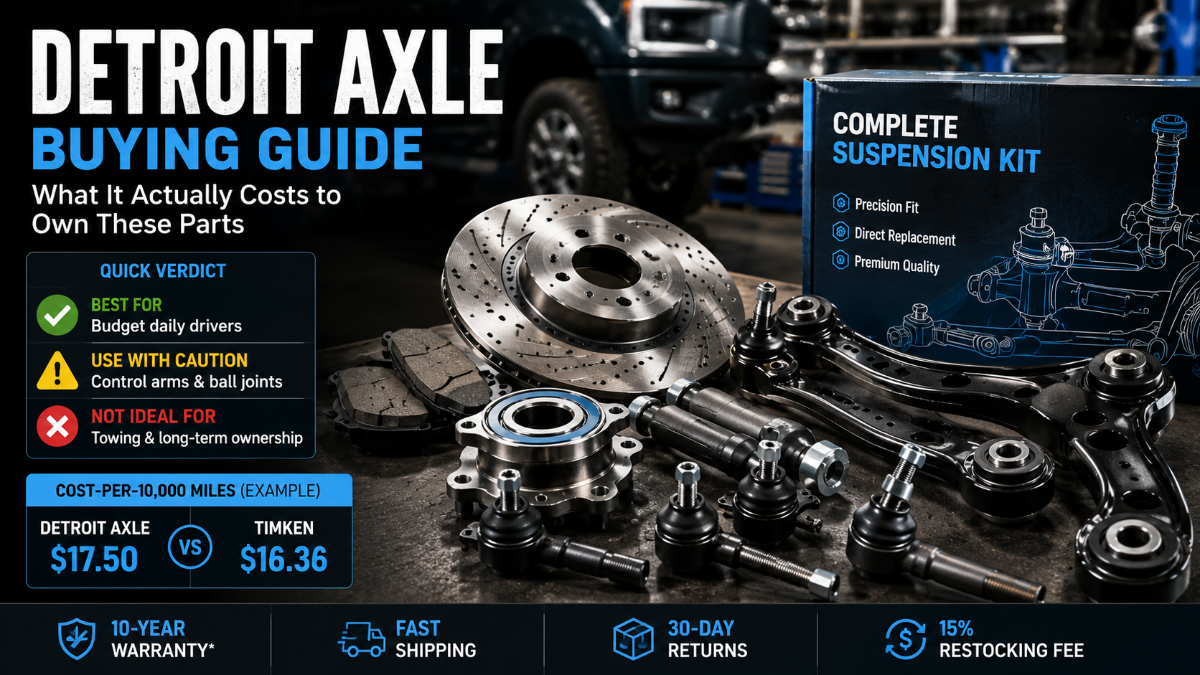
Detroit Axle is one of the most searched budget parts brands for a reason: its kits are cheap, well-packaged, and easy to find on Amazon or Walmart. But “cheap” and “worth it” aren’t the same thing, and the gap between those two ideas shows up clearly once you look past the price tag and into how these parts actually hold up.
It’s a budget after market brand best known for affordable wheel hub assemblies and brake kits, with more inconsistent quality in control arms and steering components. It works well for short-term repairs, daily commuters, or a vehicle you plan to sell soon-but it’s a riskier pick for heavy towing, high-mileage ownership, or safety-critical suspension work.
Pros vs Cons
| Pros | Cons |
| 40–70% cheaper than OEM dealer parts | Control arms show wide failure variance |
| Wheel hub assemblies frequently praised at 5–8 years of use | Warranty claims often need paid third-party inspection |
| Kits arrive correctly labeled and fit well | Restocking fees up to 25 percent reported on returns |
| Fast shipping, even in negative reviews | Independent review-platform ratings sit between roughly 1.2 and 2.3 out of 5 |
| 10-year warranty on the standard suspension line | Bushings and ball joints can fail within weeks in isolated cases |
Best Use Case Matrix
| Use Case | Verdict | Why |
| Daily driving, no towing | Buy | Load profile matches what these parts are built for |
| Short-term ownership or flipping a car | Buy | Cost savings outweigh long-term durability risk |
| Fixing a car cheaply to pass inspection | Buy | Owners consistently describe it as a workable, low-cost fix |
| Heavy towing or work-truck use | Avoid | Owners report ball joint or bushing failure within 12,000–20,000 towing miles |
| Keeping the vehicle 8+ years or past 100,000 miles | Avoid | Bushing and ball joint wear reported well before that mileage |
| Wheel hub or bearing replacement specifically | Buy | The most consistently praised category in owner feedback |
| Brake pads and rotors for daily commuting | Buy | Owners report solid stopping power at low cost |
How This Review Was Put Together
This assessment draws on hundreds of verified owner reviews, mechanic-community discussions across truck- and model-specific forums, independent teardown comparisons that physically measured Detroit Axle components against Moog equivalents, and complaint data from major consumer review platforms. That mix matters here specifically because Detroit Axle’s quality is widely reported to vary by part category rather than being uniformly good or bad-a single test kit on a single vehicle wouldn’t capture that pattern.
Also Read: Hertz Car Sales
Best Detroit Axle Parts, Ranked
Wheel hub assemblies-best category
- Owners report hubs still tight after 8 years on a full-size truck
- Zero measurable play reported after 3 years of towing on a separate vehicle
- The clearest buy recommendation across the entire catalog
Brake kits-good value
- Pads and rotors are widely described as performing like factory-fresh brakes for standard commuting
- Most negative feedback centers on warranty disputes over warped rotors, not the parts underperforming out of the box
Ball joints (sold within kits)-watch closely
- One owner found a ball joint taper hole machined larger than stock, preventing the retaining nut from fully tightening
- A separate owner reported a ball joint developing play within a year of normal use
Control arms-highest risk
- A published teardown measured Detroit Axle lower control arms against Moog equivalents and found looser bushing tolerances and more ball joint play
- Forum reports range from zero problems after five years to bushing failure within weeks on the same general part category
- Best avoided for towing vehicles or long-term ownership
CV axles-thinner track record
CV axles see less review volume and fewer independent teardowns than hubs or brake kits, so the evidence base is smaller. What feedback exists follows a pattern closer to control arms than to hubs: generally functional for light-duty use, but with more reported inconsistency than a name-brand CV axle under sustained high-torque driving.
Failure Pattern by Category
These are qualitative patterns observed across sampled owner discussions, not statistically measured failure rates. No aftermarket brand in this comparison publishes independent, controlled failure-rate data.
| Part Category | Share of Negative Feedback | Most Cited Issue |
| Control arms and ball joints | Majority of complaints | Bushing play, looseness, premature wear under towing |
| Warranty and customer service process | Roughly one-third of complaints | Paid inspection requirements, slow response, restocking fees |
| Brake components | Small minority | Warped rotors, mostly tied to claim disputes rather than pad quality |
| Wheel hubs | Smallest share | Occasional early bearing noise, usually installation-torque related |
Best Vehicles for These Suspension Kits
| Vehicle | Kit Price Range | Hub Feedback | Control Arm Feedback |
| Ford F-150 (2004–2020) | $92–$260 | Positive | Mixed, with ball joint play reported within the first year of towing |
| Chevrolet/GMC Silverado & Sierra 1500 (2007–2013) | $96–$330 | Favorable, including 8-year reports | More favorable than other platforms |
| Ram 1500 | Lower catalog depth | Limited data | Confirm coil vs. air suspension trim by VIN before buying |
| Honda Accord and other passenger cars | Simpler kits-control arms, sway bar links, hubs | Consistent | Closer to ACDelco or Duralast performance |
Trucks dominate both the product depth and the review volume for Detroit Axle suspension parts, largely because towing and heavier load profiles put these components under more stress-and generate more owner commentary either way.
What Installing a Detroit Axle Kit Feels Like
- Time: 2-4 hours for an experienced DIYer with a lift and impact tools on a full-size truck front end-comparable to OEM labor-guide times, since install time depends on the vehicle, not the parts brand
- Tools: A ball joint press or fork, torque wrench, and penetrating fluid, no unusual tooling required
- Packaging: Kits consistently arrive well-boxed and labeled per side (driver/passenger), which reduces installation errors
- Alignment: Required after any control arm or tie rod job, regardless of brand. Some owners report needing a second alignment sooner than expected, which several attribute to bushing play rather than incorrect geometry
- Torque specs: Not always included in the box-pulling factory specs from a service manual first is worth the extra step
Detroit Axle vs. Moog, ACDelco, Duralast, and TRQ
| Factor | Detroit Axle | Moog | ACDelco | Duralast | TRQ |
| Typical suspension kit price | $95–$330 | $100–$350+ | Varies by tier | AutoZone exclusive pricing | 1A Auto exclusive pricing |
| Warranty | 10-year standard line | 3-yr/36k standard, lifetime on Problem Solver | 24-month on OEM Replacement | Varies, lifetime on some Gold parts | 2-year/24,000-mile |
| Primary sourcing | China | Mix of US, Mexico, China by line | OEM line US/Mexico, budget lines overseas | Mostly overseas Tier 1 suppliers | Primarily China |
| Best category | Wheel hubs, brakes | Control arms, tie rods (Problem Solver) | OEM Replacement tier overall | Sway bar links, brake parts | Brake kits, lighting |
| Weakest category | Control arms | Budget-tier lines only | Advantage/Value tiers | Suspension joints on some models | Suspension ball joints |
| Retail availability | Own site, Amazon, Walmart | Widespread | GM dealers, auto parts stores | AutoZone only | 1A Auto, online only |
Vs. TRQ: Both brands source primarily from China and compete on price rather than premium tolerances. Owners commonly describe Detroit Axle as comparable to Duralast day-to-day but frame it as a stop-gap fix rather than a long-term investment. TRQ’s warranty is shorter on paper, but Detroit Axle’s claims process draws more complaints for requiring paid inspection before approval.
Vs. OEM: OEM dealer parts cost roughly two to three times more but carry tighter manufacturing tolerances and dealer-backed warranty support. For a vehicle kept past 100,000 miles, or any safety-critical steering component, the OEM premium typically pays for itself by avoiding a second replacement.
Related brands worth knowing: Power Stop is favored for towing-heavy braking thanks to better rotor coatings and more aggressive pad compounds. SKF is a recognized OEM-grade bearing supplier, often mentioned alongside Timken as a premium benchmark. Mevotech is a mid-tier suspension brand frequently cross-shopped against Moog and Duralast.
Also Read: Smith Machine
Wheel Bearings vs. Timken
Timken hubs commonly outlast Detroit Axle’s-100,000-plus miles versus a more typical 50,000–70,000-mile range-but cost two to three times more. For a vehicle kept long-term or driven high annual mileage, that price gap narrows quickly once a second replacement is factored in.
Lifespan Comparison
| Part Category | Detroit Axle | Moog / ACDelco OEM | Timken |
| Wheel hub or bearing | 50,000–70,000 miles | 80,000–100,000+ miles | 100,000+ miles |
| Brake pads and rotors | Standard commuter lifespan, comparable to mid-tier | Similar or slightly better rotor coating | Not a core Timken category |
| Control arms and ball joints | 12,000–45,000+ miles, wide variance | More consistent, 60,000+ miles on Problem Solver line | Not a core Timken category |
These are directional ranges compiled from owner and forum reports, not manufacturer-published lab data.
The Biggest Mistake Buyers Make
Buyers most often get burned not by the part itself, but by skipping documentation. A control arm or ball joint fails within the warranty window, but the claim gets denied or delayed because the buyer didn’t keep the installation invoice or photograph the part before fitting it. With any safety-critical part, the real risk isn’t just failure-it’s being unable to prove it should be covered when it does.
When This Brand Ends Up Costing More
Install budget control arms on a work truck and put 15,000 towing miles on them in a year, and a second replacement often arrives before a premium kit would need attention. At that point, the original savings are erased by two labor jobs and two alignments instead of one.
Is the Quality Actually Good? What Real Buyers Say
Detroit Axle’s reputation is genuinely split: parts fitment is generally praised, but customer service and warranty enforcement drive nearly every low review score. Independent review platforms rate the company as low as roughly 1.2 to 2.3 out of 5 across different snapshots, and consumer-complaint databases show hundreds of unresolved cases over a recent three-year window, with wrong parts, denied claims, and restocking fees on returns cited most often.
Common praise points
- Kits arrive correctly matched to listed vehicle fitment
- Noticeably cheaper than OEM and most name-brand aftermarket competitors
- Fast shipping, even in otherwise negative reviews
- Hub assemblies and brake components perform close to mid-tier competitor quality
Common complaints
- Customer service described as slow or unresponsive
- Warranty claims often requiring paid third-party inspection or shipping before approval
- Control arms and tie rod ends showing more inconsistent manufacturing quality than ball joints or hubs
- Restocking fees on returned items
Who Should Avoid This Brand
Consider Moog Problem Solver, ACDelco OEM Replacement, SKF, or Timken instead if:
- You tow heavy loads regularly or run a work truck with high daily mileage
- You plan to keep the vehicle 8+ years or well past 100,000 miles
- You’re specifically replacing control arms, tie rod ends, or ball joints
- You want to avoid a contested warranty claim requiring paid inspection
- You’re doing performance or off-road driving where suspension geometry precision matters
How to Buy Detroit Axle Parts Safely
- Confirm fitment using your VIN, not just year, make, and model-kits are often submodel-specific (2WD vs. 4WD, trim-level brake packages, coil vs. air suspension)
- Buy from the manufacturer’s official site or an authorized Amazon/Walmart listing to preserve warranty eligibility
- Photograph the unopened box, part numbers, and the part itself before installation
- Have parts professionally installed where possible-several warranty disputes specifically involve self-installed parts
- Keep your receipt, order confirmation, and installation invoice-warranty processing typically requires proof of purchase
Final Recommendation
Buy Detroit Axle if:
- You want the cheapest working solution for a daily driver
- You’re not towing or keeping the car long-term
- You’re replacing a wheel hub assembly or brake kit specifically
- You need a fast, low-cost fix to pass inspection
Avoid Detroit Axle if:
- You need long-term durability past 60,000–70,000 miles
- You’re replacing control arms, tie rod ends, or ball joints on a tow vehicle
- You can’t tolerate a difficult warranty claims process
- You’re doing performance, off-road, or safety-critical steering work
Bottom Line
This brand earns its budget reputation fairly in wheel hub assemblies and brake kits, where owner feedback shows performance close to mid-tier competitors at a meaningfully lower price. Control arms and tie rod ends carry more risk, backed by a published teardown against Moog and repeated forum failure reports. Buyers towing heavy loads or keeping a vehicle long-term should weigh Moog’s Problem Solver line, ACDelco’s OEM Replacement tier, SKF, or Timken instead. Confirm fitment by VIN, buy from an authorized seller, and document your purchase before you ever need a warranty claim.
Frequently Asked Questions
Is Detroit Axle good?
It performs well for wheel hub assemblies and brake kits but shows inconsistent quality in control arms and ball joints. It suits short-term repairs or light daily driving well, but it’s a riskier choice for towing or long-term ownership past 100,000 miles.
Is Detroit Axle safe to use?
Most parts meet standard OEM fitment specifications and pass routine safety inspections without issue. The safety risk concentrates in control arms and ball joints, where documented cases of excessive play or premature failure exist. Having a mechanic verify torque specs and alignment after installation meaningfully reduces this risk.
How long do Detroit Axle parts typically last?
Wheel hubs commonly last 50,000–70,000 miles, and brake components hold up similarly. Control arms and ball joints show the widest range-from as little as 12,000 miles under heavy towing to 45,000-plus miles under lighter, non-towing use. These figures are owner-reported estimates rather than manufacturer specifications.
Is Detroit Axle better than Moog?
Not on raw manufacturing tolerance. An independent teardown found a Detroit Axle lower control arm measurably lacking in quality assurance compared to a Moog equivalent, with looser bushing tolerances and more ball joint play. Detroit Axle wins on upfront price and warranty length on paper, Moog wins on consistency and claim reliability, particularly on its Problem Solver line.
Are Detroit Axle parts made in the USA or China?
New parts are primarily manufactured in China, the same sourcing model used by most budget aftermarket brands, including TRQ and Duralast’s economy lines. Some refurbished axle and steering components are remanufactured domestically at Michigan facilities, but new-component production is largely overseas.
Do Detroit Axle wheel bearings run noisy?
Occasional humming or clicking noise complaints appear in owner reviews, most often linked to improper torque during installation rather than a defective part out of the box. Following the correct torque sequence with a calibrated torque wrench substantially reduces this risk. A bearing that’s noisy from the first drive is a stronger signal of an actual manufacturing defect worth pursuing under warranty.
How does the Detroit Axle warranty compare to Moog’s?
The standard 10-year warranty is longer on paper than Moog’s standard 3-year/36,000-mile coverage, but Moog’s Problem Solver line carries a lifetime warranty on qualifying parts. In practice, warranty length matters less than claim approval rates-Detroit Axle’s process draws more complaints for requiring paid third-party inspection before honoring a claim.
What’s the actual price difference versus OEM parts?
Suspension kits typically cost 40–70% less than equivalent OEM dealer parts, with a front-end kit for a Silverado or F-150 running roughly $95–$330 versus $300–$700+ for OEM equivalents purchased individually. The savings are real, but they come with more reported variance in long-term durability, particularly for control arms.
Which Detroit Axle products should I avoid buying?
Control arms and tie rod ends carry the most reported quality inconsistency, with some units showing bushing play or ball joint failure well before the 30,000-mile mark. If you’re replacing these components on a vehicle you’re keeping long-term or using for towing, Moog’s Problem Solver line or ACDelco’s OEM Replacement tier are more consistently reviewed alternatives.
Is ACDelco or Duralast a better alternative?
It depends on the part and vehicle. ACDelco’s OEM Replacement line-not its budget Advantage or Value tiers-offers strong reliability specifically for GM vehicles, built to factory specifications. Duralast is only available through AutoZone but has improved, particularly in its Gold tier for suspension parts. Neither is a universal upgrade, both have budget sub-tiers comparable to Detroit Axle’s standard line.