
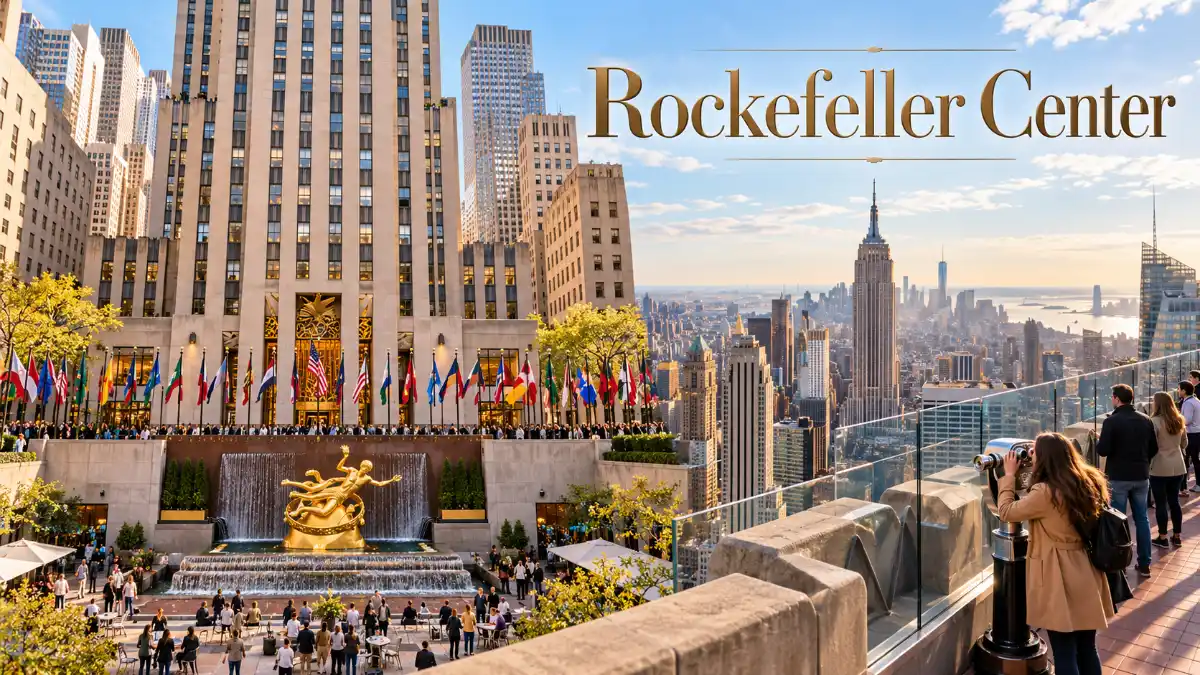
Rockefeller Center is a historic architectural and cultural complex in Midtown Manhattan, New York City, famous for its Art Deco buildings, public sculptures, Christmas tree, and ice-skating rink. Developed during the Great Depression, it became one of America’s most ambitious privately financed urban projects. Its coordinated architecture, public spaces, and artistic landmarks continue to represent an important chapter in New York City’s cultural history.
Located between Fifth and Sixth Avenues, primarily from West 48th to West 51st Streets, the complex was conceived as a “city within a city.” Rather than functioning solely as an office development, it brought together commercial buildings, entertainment venues, landscaped spaces, and public artwork. Today, visitors can appreciate much of this heritage simply by walking through its plazas and examining the architectural details.
How Rockefeller Center Became a New York City Landmark
The story of Rockefeller Center began in 1928, when John D. Rockefeller Jr. leased a large Midtown property from Columbia University. The original plan involved creating a new home for the Metropolitan Opera, but financial difficulties following the 1929 stock market crash contributed to the collapse of that proposal.
Rockefeller subsequently pursued a commercial development designed to combine offices, entertainment, retail spaces, and public areas. Construction moved forward during the Great Depression, providing employment to thousands of workers when economic opportunities were scarce.
Radio City Music Hall opened in December 1932, and the larger development reached a major opening milestone in May 1933. Construction continued throughout the decade, with the original 14-building complex officially completed in November 1939.
The project transformed a substantial section of Midtown Manhattan into a carefully planned urban environment. Its combination of skyscrapers, pedestrian spaces, cultural venues, and integrated artwork distinguished it from conventional office developments. This architectural and historical importance was formally recognized when the complex received New York City landmark designation in 1985 and National Historic Landmark designation in 1987.
What Makes Rockefeller Center’s Art Deco Architecture Special?
Rockefeller Center’s Art Deco architecture reflects the modern design movement that shaped American cities during the 1920s and 1930s. The style emphasizes geometric patterns, streamlined forms, vertical lines, decorative metalwork, and carefully arranged ornamental details.
The original development’s buildings share a recognizable architectural language, particularly through their limestone façades and strong vertical proportions. Although their heights and functions differ, the structures form a visually unified complex.
At its center stands 30 Rockefeller Plaza, originally known as the RCA Building. Completed in 1933, the skyscraper became the architectural centerpiece of the development. Its imposing entrance, setbacks, and distinctive exterior details illustrate the ambition of the original design.
Radio City Music Hall provides another celebrated example. Opened in 1932, the entertainment venue combines an Art Deco exterior with an elaborately designed interior, demonstrating how the architectural vision extended beyond commercial office towers.
Equally important is the relationship between the buildings and outdoor spaces. The Channel Gardens, Rockefeller Plaza, and pedestrian walkways create openings within Midtown’s dense street grid. These spaces also provide carefully framed views of the surrounding buildings, allowing visitors to appreciate the architecture from different perspectives.
Famous Sculptures and Public Art at Rockefeller Center
The Rockefeller Center public art collection was incorporated into the original architectural vision rather than added merely as decoration. Many sculptures explore themes of human progress, creativity, knowledge, and civilization, reflecting the artistic ideals of the period. Three works are particularly significant.
Prometheus: Created by American sculptor Paul Manship in 1934, this gilded bronze sculpture overlooks the Lower Plaza. It depicts the mythological Greek figure associated with bringing fire to humanity. Its prominent position makes it one of the complex’s most recognizable artistic landmarks.
Atlas: Situated along Fifth Avenue, the monumental bronze sculpture portrays the mythological Titan supporting the heavens. Designed by Lee Lawrie and modeled by Rene Paul Chambellan, it demonstrates the powerful, stylized human forms associated with Art Deco sculpture.
Wisdom: Above the principal entrance to 30 Rockefeller Plaza, Lee Lawrie’s Wisdom presents a symbolic figure representing intellectual achievement. Its placement connects the building’s architectural identity with the development’s broader artistic themes.
Together, these works illustrate how Rockefeller Center’s sculptures contribute meaning and character to its streets, entrances, and gathering spaces.
Rockefeller Center Christmas Tree and Ice-Skating Traditions
The Rockefeller Center Christmas tree tradition began with a modest workers’ celebration during the Great Depression. In December 1931, construction workers pooled their money to purchase and decorate a tree at the development site, creating a symbol of hope during difficult economic conditions.
The official annual Rockefeller Center Christmas tree lighting tradition began in 1933. Over subsequent decades, the illuminated tree became an internationally recognized symbol of New York City’s holiday season, drawing visitors to the plaza for a shared celebration.
Another enduring seasonal attraction is the Rockefeller Center ice skating rink, which opened on December 25, 1936.
Originally introduced as a temporary skating pond, it proved popular enough to become a recurring part of the plaza’s identity. Its location beneath the Prometheus sculpture created a distinctive setting that became familiar through photographs, films, and holiday broadcasts.
The Christmas tree and skating experience are seasonal rather than year-round attractions. The plaza, surrounding architecture, and permanent sculptures remain central features throughout the year. Because opening periods and special-event arrangements can change, visitors planning holiday experiences should confirm current schedules before arriving.
Experiencing Rockefeller Center’s History and Culture Today
Visitors interested in Rockefeller Center history and architecture can explore several important features without purchasing an observation-deck ticket.
A walk through the Channel Gardens offers a particularly useful introduction. This landscaped passage between Fifth Avenue and Rockefeller Plaza provides a framed view toward 30 Rockefeller Plaza and connects the surrounding architecture with the central public spaces.
Continuing into the Lower Plaza reveals the relationship between Prometheus, the seasonal rink area, and the buildings above. The contrasting elevations demonstrate how the original designers used different levels to create distinct public environments.
Along Fifth Avenue, Atlas and the surrounding façades reward closer inspection. Meanwhile, Radio City Music Hall represents the complex’s longstanding relationship with American entertainment and performance culture.
For a more structured experience, the Rockefeller Center guided tour explores historic landmarks, architectural details, and significant artworks. A free self-guided audio tour also offers an alternative for visitors who prefer exploring at their own pace.
Public spaces can generally be explored without an admission ticket, although guided experiences, interior attractions, and special events may require payment or advance arrangements.
The complex also continues to host temporary public art exhibitions and cultural events, introducing contemporary creative work into its historic surroundings. These changing displays give visitors another reason to explore the public spaces beyond their permanent architectural features.
Rockefeller Center’s lasting significance comes from this combination of architectural preservation and continuing public use. What began as an ambitious Depression-era development remains a place where New York City’s history, art, and communal traditions meet.
Frequently Asked Questions
Why is Rockefeller Center famous?
Rockefeller Center is famous for its Art Deco architecture, public sculptures, Radio City Music Hall, annual Christmas tree, and seasonal ice-skating rink. Its historical importance also comes from its innovative urban design and development during the Great Depression.
When was Rockefeller Center built?
Construction took place primarily during the 1930s. Major buildings opened in 1932 and 1933, while the original 14-building complex was officially completed in November 1939.
Is Rockefeller Center an Art Deco landmark?
Yes. Its coordinated architectural design, geometric decoration, limestone façades, and integrated sculptures make it an important example of American Art Deco architecture. The complex also holds New York City and National Historic Landmark designations.
What is the most famous sculpture at Rockefeller Center?
Prometheus, created by Paul Manship in 1934, is among its most recognizable sculptures. The gilded bronze artwork overlooks the Lower Plaza and depicts the mythological figure associated with bringing fire to humanity.
When did the Rockefeller Center Christmas tree tradition begin?
Workers erected the first Christmas tree at the construction site in December 1931. The official annual tradition began in 1933 and eventually became one of New York City’s best-known holiday celebrations.
When did ice skating begin at Rockefeller Center?
Ice skating began on December 25, 1936, when a temporary skating pond opened in the Lower Plaza. Its popularity helped establish the recurring winter attraction.
Can you explore Rockefeller Center without buying tickets?
Yes. Visitors can generally walk through its public plazas, admire exterior architecture, and view permanent outdoor sculptures without purchasing tickets. Guided tours, special attractions, and certain events may require paid admission.
What does the Rockefeller Center guided tour cover?
The guided tour focuses on the complex’s architectural heritage, historic buildings, notable sculptures, and cultural significance. Specific routes, access arrangements, and tour availability may vary.