
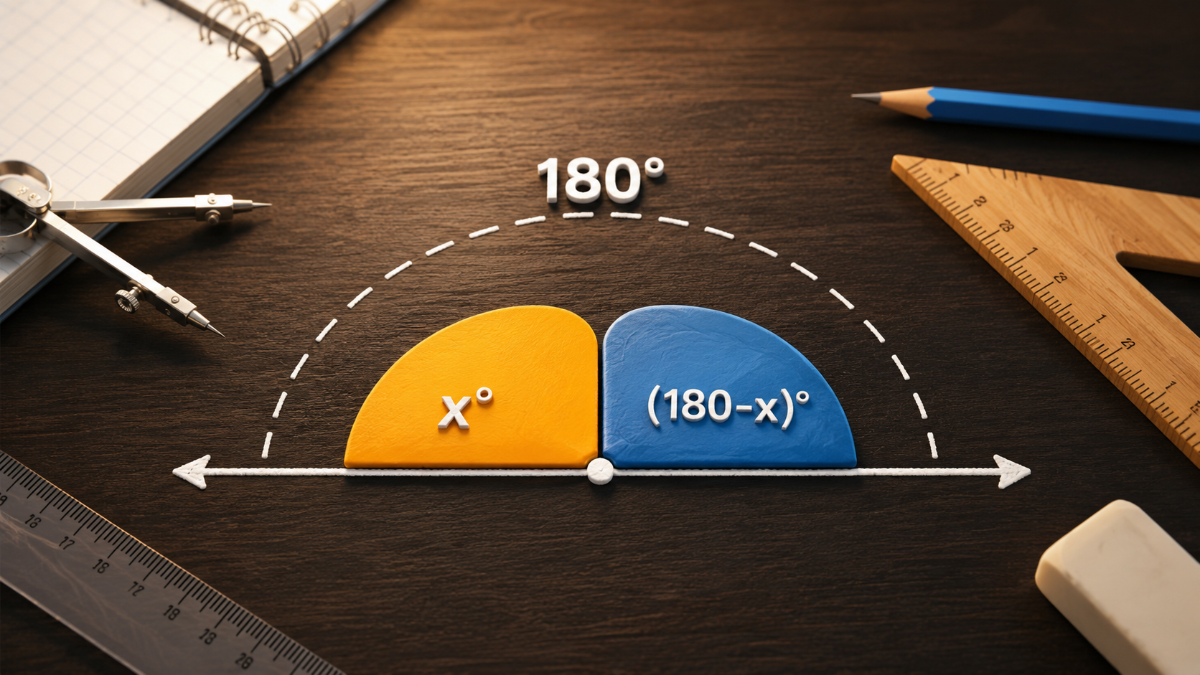
Supplementary angles are two angles whose measures add up to 180°. The supplement of an angle x is 180° − x. For example, 70° and 110° are supplementary because 70° + 110° = 180°.
Key Formula: Supplement of θ = 180° − θ
This single relationship underpins a large portion of basic and intermediate geometry-from solving for unknown angles on a straight line to proving that two roads, railway tracks, or building edges run parallel. This guide walks through the exact definition, the formula in action, how supplementary angles relate to complementary angles and parallel lines, and a full set of worked examples so you can apply the concept confidently in homework, exams, or real design problems.
Where “Supplementary” Fits Among Angle Relationships
Before going deeper, it helps to see where supplementary angles sit relative to other common angle pairs students encounter in geometry.
| Angle Relationship | Sum of Measures | Typical Position |
| Complementary angles | 90° | Adjacent or non-adjacent |
| Supplementary angles | 180° | Adjacent (linear pair) or non-adjacent |
| Vertical angles | Equal (not summed) | Opposite angles formed by two intersecting lines |
| Linear pair | 180° | Always adjacent, forming a straight line |
| Adjacent angles | Varies | Share a vertex and one side |
Supplementary angles are unique in that they’re defined entirely by a numeric outcome-a 180° sum-rather than by a fixed spatial arrangement. That single property is what makes the concept so flexible and so frequently tested in geometry problems.
Also Read: Generation Genius
Quick Definition Box
| Term | Meaning |
| Supplementary angles | Two angles whose measures sum to 180° |
| Formula | Supplement = 180° − given angle |
| Forms a straight line? | Only when the angles are adjacent and their non-common sides form opposite rays (a linear pair) |
| Symbol relationship | If ∠A + ∠B = 180°, ∠A and ∠B are supplements |
How 180° Relates to This Angle Pair
This relationship is defined purely by the sum-180°-not by position. Two angles qualify the moment their measures add up to 180°, whether or not they sit next to each other in a diagram.
180° also happens to be the measure of a straight angle. When the two angles are adjacent and their non-common sides point in exactly opposite directions, they form a straight line-this specific case is called a linear pair. But not every such pair forms a straight line, two angles in completely separate parts of a figure can still qualify as long as their sum is 180°.
It’s worth noting that the term “supplement” comes from the idea of completing something to a whole-in this case, completing an angle to a straight angle of 180°. This is different from a “complement,” which completes an angle to a right angle of 90°. Keeping this linguistic distinction in mind can help avoid mixing up the two concepts during problem-solving.
Adjacent and Non-Adjacent Supplementary Angles
These angle pairs commonly appear in two positional arrangements. These aren’t a rigid formal classification-just two practical ways the same 180° relationship shows up in geometry problems.
Adjacent Supplementary Angles (Linear Pair)
When two angles share a common vertex and a common side, and their other two sides point in opposite directions, they form a linear pair-a straight line split into two parts by a single ray.
Supplementary describes a relationship between angle measures. Linear pair describes a relationship between position and measure. Every linear pair fits this sum-based definition, but not every pair that fits it has to form a linear pair.
A useful way to visualize this: imagine a straight fence line, with a single post placed somewhere along it that isn’t at either end. If a diagonal wire runs from that post to the ground, it splits the straight angle formed by the fence into two angles. No matter where that post sits, the two resulting angles will always sum to 180°.
Non-Adjacent Pairs
Non-adjacent pairs don’t share a vertex or a side. They could sit in different corners of the same diagram or belong to entirely separate figures-as long as their measurements total 180°, the relationship holds. For example, a 65° angle in one triangle and a 115° angle in an unrelated figure qualify purely because 65° + 115° = 180°, even though neither touches the other.
This distinction matters most in proof-based geometry, where a problem might state that two angles are supplementary without showing them adjacent in the diagram at all. Recognizing that adjacency isn’t required prevents a common early misunderstanding.
Supplementary Angles Formula
To find the missing value, subtract the known angle from 180°: Supplement = 180° − given angle.
| Given Angle | Formula | Supplementary Angle |
| 35° | 180° − 35° | 145° |
| 60° | 180° − 60° | 120° |
| 90° | 180° − 90° | 90° |
| 125° | 180° − 125° | 55° |
| 172° | 180° − 172° | 8° |
How to Identify Supplementary Angles
Use this three-step check on any angle pair:
- Confirm there are exactly two angles-this is strictly a two-angle relationship, not three or more.
- Determine each angle’s measure-from a given value, an equation, or a diagram property (linear pair, same-side interior angles, etc.).
- Add the two measures. If the total equals 180°, the angles are supplementary.
If the sum doesn’t equal 180°, the angles simply aren’t supplementary-they may still have another relationship, such as complementary (90°) or congruent (equal), depending on the context of the problem.
Complementary vs. Supplementary Angles
| Feature | Complementary Angles | Supplementary Angles |
| Sum of angles | 90° | 180° |
| Forms | A right angle | A straight angle (only when adjacent as a linear pair) |
| Formula | 90° − given angle | 180° − given angle |
| Example pair | 30° and 60° | 70° and 110° |
| Can both angles be equal? | Yes (45° + 45°) | Yes (90° + 90°) |
Memory tip: “C” (complementary) comes before “S” (supplementary) alphabetically, and 90 comes before 180 numerically.
A common exam-style question asks students to find an angle that is both a specific value away from its complement and its supplement simultaneously. For instance, if an angle’s supplement is three times its complement, you can set up the equation 180° − x = 3(90° − x), which simplifies to 180° − x = 270° − 3x, giving 2x = 90°, so x = 45°. Problems like this reinforce why understanding both relationships together-not in isolation-builds stronger algebraic geometry skills.
Read More: Hertz Car Sales
Parallel Lines and the Transversal Connection
When a transversal crosses two parallel lines, two specific angle relationships always produce a 180° sum. Same-side interior angles, also called co-interior angles, sit between the parallel lines on the same side of the transversal. Same-side exterior angles sit outside the parallel lines, on the same side of the transversal. From here, this guide uses “same-side interior” and “same-side exterior” consistently.
Separately, at each point where the transversal crosses a line, any two adjacent angles form a linear pair and are therefore supplementary-this holds true regardless of whether the lines are parallel.
It helps to distinguish this from other transversal angle pairs that are not supplementary. Corresponding angles and alternate interior angles formed by a transversal across parallel lines are congruent (equal), not supplementary. Mixing these up is one of the most frequent errors students make when working through parallel-line proofs, so it’s worth double-checking which specific angle pair a problem is referencing before applying a formula.
The Converse: Proving Lines Are Parallel
This relationship also works in reverse. If a transversal cuts two lines and a pair of same-side interior angles adds up to 180°, the converse theorem confirms the two lines are parallel. This converse is a standard method for proving parallelism in geometric proofs without measuring the lines directly.
This converse has practical value beyond the classroom. Surveyors and engineers occasionally verify that two structural lines are parallel by measuring a same-side interior angle pair at a known transversal crossing and confirming the sum equals 180°, rather than measuring the full length of both lines.
Supplementary Angles Theorem
If two angles are each supplementary to the same angle (or to congruent angles), the two angles are congruent to each other.
In formula form:
∠A + ∠C = 180° and ∠B + ∠C = 180°, therefore ∠A = ∠B.
This theorem is commonly used in two-column geometric proofs to establish that two angles are equal without measuring them, simply by showing each shares a 180° relationship with the same reference angle. Note that this theorem proves congruence, not that a given pair is itself supplementary-that requires a separate check, such as confirming a linear pair, a same-side interior angle relationship with parallel lines, or a direct sum calculation.
A related and frequently confused idea is the Congruent Supplements Theorem, which is essentially the same statement phrased differently: angles supplementary to congruent angles are themselves congruent. Recognizing that these are two names for the same underlying logic can save confusion when studying from different textbooks or resources.
Step-by-Step Solved Examples
Example 1: Finding a Missing Angle
Problem: Angle A measures 62°. Find its supplement.
- Apply the formula: Supplement = 180° − given angle.
- Supplement = 180° − 62° = 118°.
Answer: The supplement is 118°.
Example 2: Solving for x in a Linear Pair
Problem: Two angles on a straight line measure (3x + 15)° and (2x + 25)°. Find x.
- Since the angles form a linear pair, their sum is 180°: (3x + 15) + (2x + 25) = 180.
- Combine like terms: 5x + 40 = 180.
- Subtract 40: 5x = 140.
- Divide by 5: x = 28.
Answer: x = 28. (Check: 99° + 81° = 180° ✓)
Example 3: Same-Side Interior Angles With Parallel Lines
Problem: Two parallel lines are cut by a transversal. One same-side interior angle measures 105°. Find the other.
- Same-side interior angles between parallel lines sum to 180°.
- Other angle = 180° − 105° = 75°.
Answer: The other angle is 75°.
Example 4: Solving for Both Angle Measures
Problem: Two angles are represented as (4x − 10)° and (x + 30)°, and their sum is 180°. Find x and each angle’s measure.
- Set up the equation: (4x − 10) + (x + 30) = 180.
- Combine like terms: 5x + 20 = 180.
- Subtract 20: 5x = 160.
- Divide by 5: x = 32.
- Substitute back: first angle = 4(32) − 10 = 118°, second angle = 32 + 30 = 62°.
Answer: x = 32, and the two angles measure 118° and 62° (Check: 118° + 62° = 180° ✓).
Example 5: Using the Congruent Supplements Theorem
Problem: ∠A is supplementary to ∠C, and ∠B is supplementary to ∠C. If ∠A measures (2x + 20)° and ∠B measures (3x − 10)°, find x and confirm ∠A ≅ ∠B.
- Since both angles are supplementary to the same angle ∠C, the theorem states ∠A = ∠B.
- Set the expressions equal: 2x + 20 = 3x − 10.
- Subtract 2x from both sides: 20 = x − 10.
- Add 10: x = 30.
- Substitute back: ∠A = 2(30) + 20 = 80°, ∠B = 3(30) − 10 = 80°.
Answer: x = 30, and ∠A = ∠B = 80°, confirming the theorem.
Practice Problems
Try these independently, then check your answer below each one.
1. Find the supplement of 84°.
Answer: 180° − 84° = 96°
2. Two angles on a straight line measure (2x + 10)° and (3x − 20)°. Find x.
Answer: 2x + 10 + 3x − 20 = 180 → 5x − 10 = 180 → 5x = 190 → x = 38
3. Two parallel lines are cut by a transversal, and one same-side interior angle measures 132°. Find the other.
Answer: 180° − 132° = 48°
4. An angle’s supplement is four times the angle itself. Find the angle.
Answer: Let the angle be x. Then 180° − x = 4x → 180° = 5x → x = 36°
Common Mistakes to Avoid
- Confusing this relationship with complementary angles: Check whether the problem needs a sum of 90° or 180°.
- Assuming every such pair forms a straight line: Only adjacent pairs forming a linear pair do this.
- Applying the concept to three or more angles: The relationship applies strictly to angle pairs.
- Treating a linear pair and this angle relationship as identical: Every linear pair fits the definition, but not every pair that fits it is a linear pair.
- Mixing up corresponding/alternate angles with same-side interior angles: Only same-side interior and same-side exterior angle pairs sum to 180° across parallel lines, corresponding and alternate interior angles are equal, not supplementary.
- Forgetting to verify algebraic answers: After solving for an unknown, always substitute back and confirm the two angles actually sum to 180°.
Frequently Asked Questions
What is the supplement of a right angle?
The supplement of a 90° right angle is another 90° angle, since 180° − 90° = 90°. This is the only case where an angle shares this relationship with an angle of the exact same measure as itself.
Can two obtuse angles be supplementary?
No. An obtuse angle measures more than 90°, so two obtuse angles would always sum to more than 180°. A valid pair must be either two right angles or one acute angle paired with one obtuse angle.
Can two acute angles be supplementary?
No. An acute angle measures less than 90°, so two acute angles can never total 180°-their combined sum will always fall short. At least one angle in a valid pair must be either a right angle (90°) or an obtuse angle (greater than 90°).
What is the supplement of a 0° angle?
The supplement of a 0° angle is 180°, since 180° − 0° = 180°. This case is mostly theoretical, as a 0° angle represents no rotation and rarely appears in applied geometry problems.
How do you prove two angles are supplementary without measuring them?
You can establish this relationship through geometric reasoning instead of direct measurement-for example, by showing the angles form a linear pair, by using the same-side interior angle relationship when the two lines cut by a transversal are known to be parallel, or by deriving each angle’s measure algebraically and confirming their sum equals 180°.
Are vertical angles the same as supplementary angles?
No. Vertical angles are the pair of opposite angles formed when two lines intersect, and they are always equal (congruent) to each other, not supplementary. However, each vertical angle is supplementary to the two angles adjacent to it, since those adjacent pairs form linear pairs along the intersecting lines.
Do supplementary angles always add up to exactly 180°, or can there be rounding tolerance?
In pure geometry, supplementary angles must sum to exactly 180° with no tolerance. In applied fields like construction, surveying, or CAD design, small measurement tolerances are sometimes accepted for practical purposes, but the mathematical definition itself requires an exact 180° total.
How is the concept of supplementary angles used in polygon angle calculations?
Supplementary relationships often appear when working with the interior and exterior angles of a polygon at a single vertex, since an interior angle and its adjacent exterior angle always form a linear pair and therefore sum to 180°. This connection is frequently used to convert between interior and exterior angle measures when solving polygon-related problems.
What’s the difference between a supplement and a complement in geometry?
A supplement completes an angle to 180° (a straight angle), while a complement completes an angle to 90° (a right angle). The terms come from the idea of “completing” a given angle to one of these two reference values, and mixing them up is one of the most common errors students make on geometry tests.
Can three or more angles be described as supplementary if their total is 180°?
No. The term “supplementary” applies strictly to a pair of two angles. If three or more angles sum to 180°, they are simply angles whose combined total equals 180°, this is a different situation from a supplementary pair and doesn’t carry the same linear-pair or parallel-line implications.