
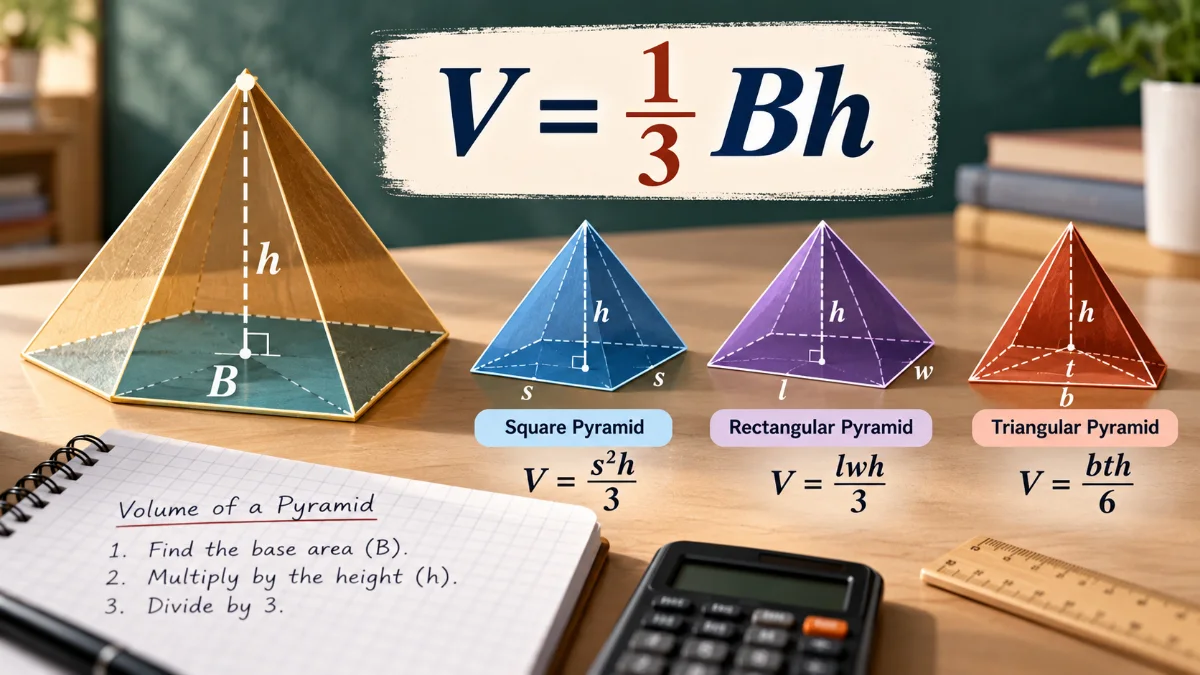
The pyramid volume formula is V = (1/3)Bh, where V is the volume, B is the area of the pyramid’s base, and h is its perpendicular height. To calculate the volume of a pyramid, find the base area, multiply it by the perpendicular height, and divide by three. The same formula works for square, rectangular, triangular, and other polygon-based pyramids.
Volume is measured in cubic units, such as cubic inches (in³), cubic feet (ft³), or cubic centimeters (cm³). The most important thing to remember is that the formula uses perpendicular height, not the slant height measured along a side face.
What Is the Pyramid Volume Formula?
The standard formula is:
V = (1/3)Bh
Each variable represents a particular measurement:
- V = Volume: The amount of three-dimensional space the pyramid occupies.
- B = Base area: The area of the polygon forming the bottom of the pyramid.
- h = Height: The perpendicular distance from the apex (the top point) to the plane of the base.
You can also write the formula as:
V = Bh/3
Both expressions give the same answer. Although the base shape changes from one pyramid to another, the basic formula stays the same. This relationship also applies to right and oblique pyramids, provided you use the correct perpendicular height.
How to Find the Volume of a Pyramid
You can calculate pyramid volume in three straightforward steps:
- Find the base area. Use the area formula for the shape at the bottom of the pyramid.
- Multiply by the perpendicular height. Check that your measurements use compatible units.
- Divide by three. Write the answer in cubic units.
For example, imagine a pyramid with a base area of 30 square inches and a perpendicular height of 9 inches.
Substitute the measurements into the pyramid volume formula:
V = (30 × 9)/3
V = 270/3 = 90 in³
The pyramid has a volume of 90 cubic inches.
Pyramid Volume Formulas for Different Base Shapes
Every pyramid uses the same general volume formula. What changes is how you calculate its base area. Knowing the correct area formula for each shape makes the process much easier.
| Pyramid Type | Base Area Formula | Volume Formula |
| Square pyramid | B = s² | V = s²h/3 |
| Rectangular pyramid | B = lw | V = lwh/3 |
| Triangular pyramid | B = bt/2 | V = bth/6 |
In the table, s is the side length of a square, l and w are the length and width of a rectangle, b and t are the base and perpendicular altitude of a triangle, and h is the perpendicular height of the entire pyramid.
Read more: Supplementary Angles: Definition, Formula, Examples & Solved Problems
Volume of a Square Pyramid
A square pyramid has a square base and four triangular side faces that meet at the apex. To find its volume, square the base’s side length, multiply by the pyramid’s perpendicular height, and divide by three.
V = s²h/3
Example: A square pyramid has a base side measuring 6 inches and a perpendicular height of 9 inches.
Start by finding the base area:
B = 6 × 6 = 36 in²
Now calculate the volume:
V = (36 × 9)/3 = 108 in³
Answer: The square pyramid has a volume of 108 cubic inches.
Volume of a Rectangular Pyramid
A rectangular pyramid has a rectangular base. Since the area of a rectangle is its length multiplied by its width, the volume formula becomes:
V = lwh/3
Example: A rectangular pyramid has a base length of 8 feet, a width of 5 feet, and a perpendicular height of 6 feet.
First, calculate the base area:
B = 8 × 5 = 40 ft²
Next, use that area to calculate the volume:
V = (40 × 6)/3 = 80 ft³
Answer: The rectangular pyramid has a volume of 80 cubic feet.
Volume of a Triangular Pyramid
A triangular pyramid has a triangular base and three other triangular faces. Before calculating its volume, you need the area of the base triangle.
The formula is:
V = bth/6
Here, b is the triangle’s base length, t is its perpendicular altitude, and h is the height of the entire pyramid. Remember that the triangle’s altitude and the pyramid’s height are two different measurements.
Example: A triangular pyramid has a triangular base measuring 6 centimeters along one side, with a perpendicular altitude of 4 centimeters. The pyramid itself has a perpendicular height of 9 centimeters.
Calculate the area of the triangular base:
B = (6 × 4)/2 = 12 cm²
Then calculate the volume:
V = (12 × 9)/3 = 36 cm³
Answer: The triangular pyramid has a volume of 36 cubic centimeters.
The distinction between the triangle’s altitude and the pyramid’s height matters. Using one in place of the other will give you the wrong volume.
Why Is Pyramid Volume Divided by Three?
A pyramid has exactly one-third the volume of a prism with the same base area and perpendicular height.
A prism’s volume is calculated using:
Vprism = Bh
For a pyramid, the formula includes an additional division by three:
Vpyramid = Bh/3
Consider a prism with a base area of 50 square inches and a height of 12 inches. Its volume is 600 cubic inches.
A pyramid with the same base area and height has a volume of:
V = (50 × 12)/3 = 200 in³
The pyramid occupies one-third as much space as the prism. The difference comes from the pyramid’s shape: as you move from its base toward the apex, cross-sections parallel to the base become progressively smaller.
This one-third volume relationship is a fundamental geometric property and holds for both right and oblique pyramids.
Common Mistakes When Calculating Pyramid Volume
Knowing the formula is only part of the process. A small mistake in choosing measurements or handling units can change the answer.
Confusing slant height with perpendicular height: Slant height is measured along a triangular side face, while perpendicular height is the shortest distance from the apex to the plane of the base. Only perpendicular height belongs directly in the volume formula.
For a right square pyramid, if the base side length s and face slant height ℓ are known, you can calculate perpendicular height using:
h = √(ℓ² − (s/2)²)
This equation works for a right square pyramid. Other pyramid shapes or orientations may require different measurements or relationships.
For a clearer distinction between these measurements, see the explanation of vertical height and slant height.
Using a side length instead of base area: The formula requires the area of the entire base. If the base is rectangular, for example, you need both its length and width.
Forgetting to divide by three: Multiplying base area by height gives the volume of a corresponding prism. You must divide that result by three to find the pyramid’s volume.
Mixing measurement units: If the base dimensions are in feet and the height is in inches, convert them to compatible units before calculating.
Using square units instead of cubic units: Base area is measured in square units, such as in² or cm². Volume is measured in cubic units, including in³, ft³, cm³, and m³.
How to Find Missing Pyramid Measurements
You can also rearrange the pyramid volume formula to work backward. If you know the volume and base area, you can calculate the perpendicular height. If you know the volume and height, you can find the base area.
Finding the Height of a Pyramid
When the volume and base area are known, use:
h = 3V/B
Example: A pyramid has a volume of 120 cubic inches and a base area of 40 square inches.
h = (3 × 120)/40 = 9 inches
The pyramid’s perpendicular height is 9 inches.
Finding the Base Area of a Pyramid
If the volume and perpendicular height are known, rearrange the formula as follows:
B = 3V/h
Example: A pyramid has a volume of 180 cubic centimeters and a perpendicular height of 12 centimeters.
B = (3 × 180)/12 = 45 cm²
The base area is 45 square centimeters. You may still need additional measurements to calculate individual side lengths, depending on the base shape.
Frequently Asked Questions
Can you find pyramid volume using only the slant height?
No. Slant height alone doesn’t provide enough information to determine the volume. You also need suitable base measurements and enough geometric information to calculate the perpendicular height. For a right square pyramid, knowing the base side length and face slant height allows you to find the perpendicular height using the Pythagorean theorem.
How do you use a pyramid volume calculator?
Choose the pyramid’s base shape and enter the required base dimensions and perpendicular height. The calculator finds the base area, multiplies it by the height, and divides by three. Make sure your inputs use compatible measurement units and check that the final volume is expressed in cubic units.